
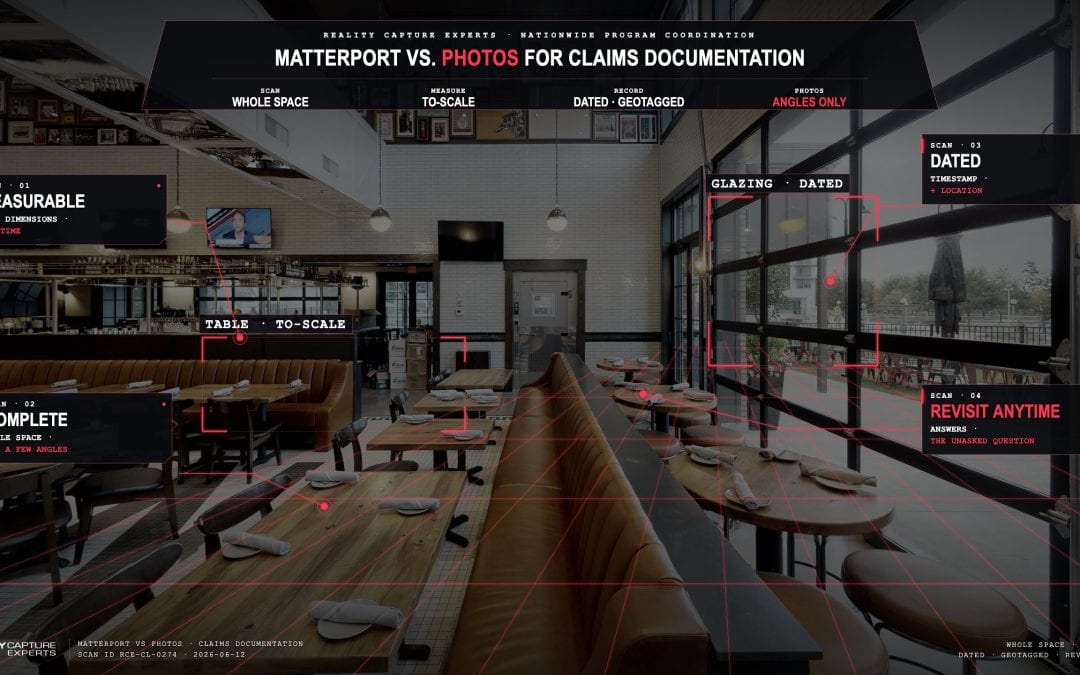
Matterport vs. photos for claims makes the difference in measurability and capture completeness. Photos show whatever someone pointed the camera at, at one moment, with no scale. A Matterport capture records the entire space to scale, with embedded measurements, a date, and a location — so you can revisit any part of the building and pull dimensions later. For claims, that means a scan answers questions no one thought to ask at capture time, while a photo set only answers the ones someone anticipated.
Matterport vs. photos for claims documentation: Both have a place. But for the documentation that has to hold up — pre-loss baselines, replacement-cost evidence, contested claims — the gap is wide. This post sits under our broader guide to pre-loss property documentation.
What can a scan do that photos can’t?
One Matterport service visit captures the whole space, not a selection of angles. You can measure a wall, a ceiling height, or a clearance after the fact, because the geometry is recorded. You can navigate the building as it existed on a specific date. And the file carries its own timestamp and location, which photos generally do not.
The practical test is the question you didn’t plan for. When a claim turns on the condition of a corner no one photographed, a scan still has it. A photo set does not.
Are photos ever enough?
For quick, low-stakes records, photos can be fine. The problem is that you rarely know in advance which documentation will be low-stakes. A folder of phone photos can’t prove dimensions, can’t show areas no one captured, and usually can’t prove its own date. When a claim is contested, those gaps become the argument against you.
That is the same reason a scan is easier to defend — covered in what makes a 3D property scan defensible. The completeness and the embedded date are exactly what hold up under scrutiny.
Which is better for replacement cost and valuation?
A scan, clearly. Replacement cost depends on accurate dimensions and a record of construction and finishes — and you cannot pull a measurement out of a photo. A capture lets a valuation team work from measured reality, which is why it underpins documenting replacement cost value. Photos can supplement that record, but they cannot anchor it.
What about cost and effort — aren’t photos easier?
Per building, photos feel easier. Across a portfolio, the math flips. A Matterport model is one dated, complete record per site that serves underwriting, valuation, and claims at once, instead of re-photographing every time a new question comes up. And when the capture is run as a managed program, the effort moves off your team entirely — which is the point of running pre-loss surveys across many locations.
How does RCE handle this for clients?
RCE captures each site as a complete, dated Matterport record with measurable geometry, then delivers it in a consistent format across the portfolio. Photos can be part of the package where they add value, but the foundation is a measurable scan — one record per site that holds up for underwriting, valuation, and claims, captured to one standard nationwide.
What happens next
If your current documentation is mostly photos, the next step is a baseline: a complete, dated scan of each site you want covered. RCE confirms scope, which locations to capture, runs the capture to one standard, and delivers a measurable record you can rely on.
Frequently asked questions
Do scans replace photos entirely?
Not necessarily. A scan is the measurable, complete foundation; photos can supplement it for specific detail. RCE delivers the scan as the record of record and includes photos where they add value.
Can you measure from a Matterport scan after the fact?
Yes. Because the geometry is captured, you can pull dimensions later — including for areas no one specifically measured on site.
Is a scan worth it for lower-value buildings?
Often yes, because you rarely know in advance which documentation a claim will turn on. Many owners apply one standard across the portfolio so every site is covered the same way.