
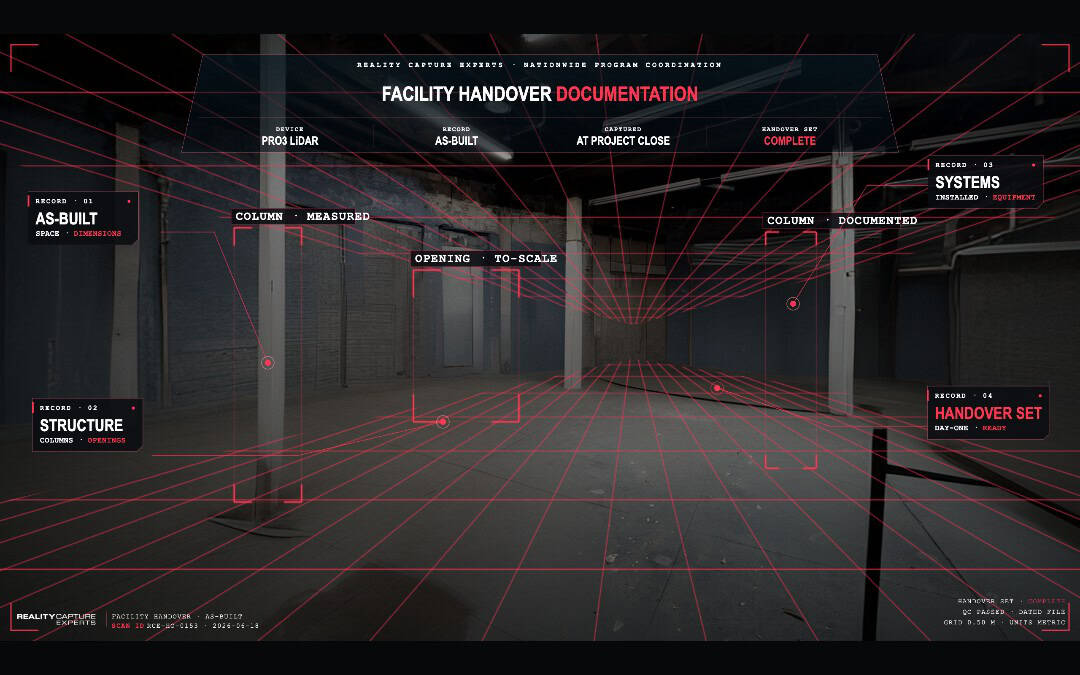
Facility handover documentation should include an accurate as-built record of the space as actually built, the systems and equipment installed, and a navigable visual reference the operations team can use day one — not just a stack of paper the facilities team has to re-key. The test of good handover is simple: can the people who run the building find what they need without going back to the contractor?
Too often handover delivers documents that provide little practical value, and facilities managers end up rebuilding the information themselves. This post covers what handover should actually contain, why an as-built capture belongs in it, and how consistent documentation makes handover useful across a portfolio of projects.
Why does traditional facility handover documentation fall short?
It falls short because it is built to close out a project, not to run a building. Contractors deliver what the contract specifies, which is often a pile of PDFs and binders that the operations team cannot easily search, verify, or trust.
The deeper problem is that the documents rarely reflect the building as actually built. Last-minute field changes do not always make it into the record, so the facilities team inherits drawings that are already wrong. They then spend months re-keying information and re-verifying conditions — work that a proper as-built capture at handover would have prevented.
What should be in a useful handover package?
A useful handover package should include an accurate as-built record, documentation of installed systems and equipment, and a navigable visual reference tied to the real space. The aim is a record the operations team can rely on from day one.
A Matterport 3D digital twin captures the space as actually built, with measurements throughout, so the operations team can navigate any room and confirm what is there. Where engineering detail is needed, the same capture supports a LiDAR point cloud and accurate floor plans, and feeds scan-to-BIM at a defined level of detail. Capturing at the moment of handover locks in an accurate baseline before the building starts changing — the foundation for the space data and condition assessments that follow.
How do you make facility handover documentation consistent across many projects?
You make it consistent by capturing every project to the same handover standard, regardless of which contractor or market it came from. Consistency at handover is what lets a facilities team treat a portfolio of buildings as one manageable system instead of dozens of one-off records.
When handover capture is left to each project team, the output varies with every contractor — different formats, different coverage, different reliability. A managed program fixes the standard and applies it everywhere. RCE captures each project to the same scope at handover, runs QC on every deliverable, and delivers consistent formats, so a new building enters the portfolio documented exactly like the rest — the same discipline behind documenting facilities across multiple locations consistently.
Frequently Asked Questions
When should facility handover documentation capture happen?
At or near project close, once construction is substantially complete, so the record reflects the building as actually built before it starts changing. Coordinating the timing is part of a managed program.
What formats does handover documentation come in?
A Matterport 3D digital twin for navigation and measurement, plus, where needed, a LiDAR point cloud in open formats such as E57 or RCP, 2D floor plans, and scan-to-BIM at a defined level of detail.
How does as-built capture save the operations team time?
It removes the re-keying and re-verification that traditional handover forces on facilities teams. Instead of rebuilding the record, they start from an accurate, navigable one.
Can RCE match our handover standard across all contractors?
Yes. RCE applies one capture standard at handover regardless of contractor or market, with QC on every deliverable, so every building enters your portfolio documented the same way.
What Happens Next
For facility handover documentation, RCE captures the as-built condition at project close to a defined scope — a navigable 3D record, measurements, and any required point cloud, floor plans, or BIM — and applies that standard across every project in the portfolio. We coordinate scheduling so capture happens at the right moment, deploy operators who follow one procedure, and QC each deliverable before it reaches the operations team. The result is a handover record the facilities team can actually use on day one, consistent with every other building they manage — instead of a binder they have to rebuild.