
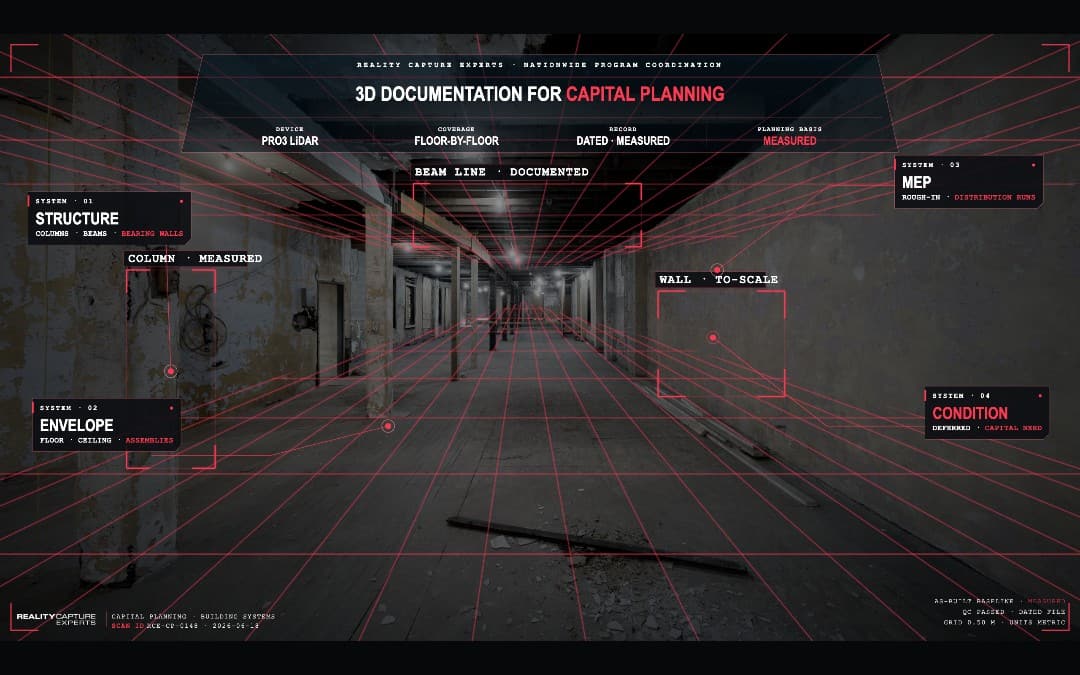
3D documentation supports capital planning by giving every funding decision traceable, measurable evidence — so condition findings, replacement-cost estimates, and prioritization all tie back to what was actually documented on-site. A capital plan is a set of arguments for spending money. The stronger the evidence behind each line, the easier it is to fund the right work in a constrained budget cycle.
Budget constraints are the number-one challenge facilities teams report, and years of deferred maintenance have built a backlog that compounds annually. This post explains how 3D documentation strengthens capital requests, how it helps prioritize a backlog, and how consistent capture across a portfolio makes the whole plan defensible.
How does documentation strengthen a capital request?
It strengthens a request by replacing assertion with evidence. A line item that says “replace rooftop unit, $X” is far more fundable when it links to a navigable record of that exact unit, its observed condition, and the measurements behind the cost estimate.
Decision-makers approving capital want to see why this building and this system, ahead of others. 3D documentation lets them look at the evidence directly instead of taking the request on faith. That traceability — finding to evidence to cost — is what moves a request from “maintenance wish list” to a defensible budget line. It is the same evidence base described in what a facility condition assessment should capture.
How does it help prioritize a deferred-maintenance backlog?
It helps by making conditions across the portfolio visible and comparable, so you can rank the backlog by real risk and condition rather than by whoever asks loudest. Equipment built to last 15 years is being stretched to 25, and not every aging asset is an equal priority.
When every site is documented the same way, you can compare a failing roof in one region against an overloaded electrical room in another and make a defensible call about which gets funded first. Without consistent documentation, prioritization defaults to anecdote. With it, the backlog becomes a ranked, evidence-backed plan — which depends on documenting facilities across multiple locations consistently.
Why does consistency matter for a multi-year capital plan?
Consistency matters because a capital plan spans years and buildings, and the data has to hold together across both. If each site’s documentation was produced differently, the plan rests on apples-to-oranges comparisons that fall apart under scrutiny.
A managed capture program keeps the evidence base uniform. RCE captures every site to the same scope, runs the same QC on every deliverable, and can re-capture on a defined cadence so the plan reflects current conditions year over year. That consistency is what lets leadership trust a multi-year plan built across a large, geographically spread portfolio — the alternative, stitching together local vendors site by site, rarely produces comparable data. For the cost side of the evidence, see facility condition assessments and capital planning.
What happens next / How RCE handles this
For capital-planning support, RCE scopes capture to produce the evidence your plan relies on — navigable records, measurements, and condition documentation tied to specific assets and spaces — applied the same way at every site. We coordinate nationwide, deploy operators who follow one procedure, and QC each deliverable before delivery. Your planners build requests and prioritize the backlog on evidence that traces back to the building, consistent across the portfolio. We can schedule re-capture so the plan stays current as conditions and budgets change. Your team owns the financial decisions; we make sure the documentation behind them holds up.
Frequently asked questions
Does RCE produce cost estimates or the capital plan?
No. RCE delivers the reality capture and documentation behind the plan. Your planners, engineers, or cost estimators produce the figures; our role is to give them consistent, traceable evidence at every site so those figures hold up under review.
How does 3D documentation reduce planning risk?
It reduces the risk of funding the wrong work. When conditions are documented and comparable across sites, prioritization is based on evidence rather than anecdote, and approved budgets map to real, verifiable need.
Can documentation be reused across budget cycles?
Yes. A navigable record captured this year remains a reference next cycle, and scheduled re-capture keeps it current — so each plan builds on the last rather than starting over.
How does this work for a large, spread-out portfolio?
RCE coordinates capture nationwide through a single point of contact, applying one standard at every location. That is what makes evidence comparable across a portfolio that spans many markets.