
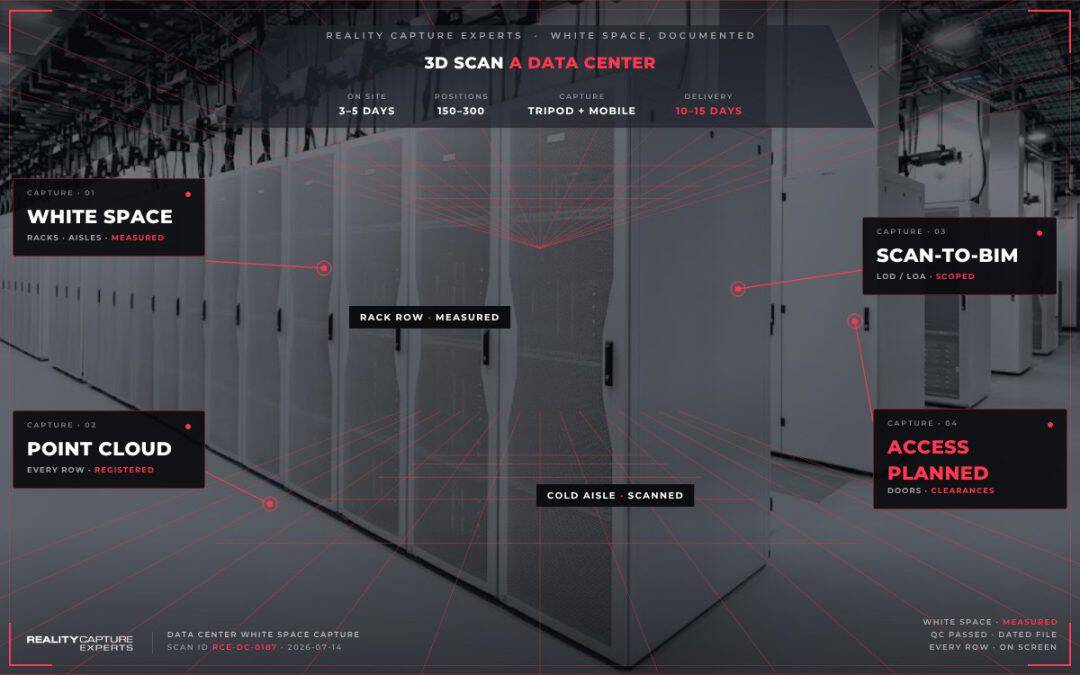
To 3D scan a data center takes about one day for a single data hall and three to five days for a full facility that includes white space, sub-floor, mechanical rooms, electrical rooms, and the exterior. Point cloud deliverables usually follow in 10 to 15 business days. The timeline depends on square footage, equipment density, and site access rules.
That is the short answer. Most of the schedule risk when you 3D scan a data center has nothing to do with scan speed and everything to do with access coordination. This guide covers what drives the timeline and how RCE keeps the on-site days predictable. It is a companion to our pillar on reality capture for data centers.
What drives the time it takes to 3D scan a data center?
Three factors drive it: floor area, equipment density, and access. Density matters more than people expect. Equipment blocks lines of sight, so the white space needs far more scan positions than an open office of the same size. A 20,000 square foot white space commonly needs 150 to 300 scan positions, versus roughly 80 to 120 for a comparable office floor. More positions means more time, which is why we plan positions around the actual room conditions rather than a generic grid.
How is capture equipment matched to the space?
Tripod laser scanners deliver the tightest accuracy and are used in mechanical and electrical rooms where geometry has to be precise. Mobile capture covers large white space floors quickly. Matterport provides the navigable, photoreal digital twin on top of the point cloud. Matching the tool to the area keeps the day count reasonable without giving up accuracy where it matters.
Why access coordination decides how fast you 3D scan a data center
A data center is a secured, live environment, and the scan cannot start until access is real. Facilities that follow Uptime Institute operations practices enforce background checks, escort requirements in multi-tenant space, restricted zones, photography policies, and equipment rules. If those are sorted on arrival instead of in advance, a three-day scan turns into a week of waiting. RCE confirms badging, escorts, and restricted-area rules before the field team travels, which is the difference between a predictable schedule and a costly delay.
How soon are deliverables ready?
After field work, a full-facility dataset is processed and delivered in about 10 to 15 business days, depending on scope and required accuracy. Processing includes registration, cleanup, and QC before anything reaches you. The required level of detail affects both effort and timeline, which we cover in what LOD and LOA data center MEP as-builts need.
Frequently Asked Questions
How long does it take to 3D scan a data center data hall?
A single data hall is often captured in about one day. A full facility with white space, sub-floor, mechanical, electrical, and exterior typically runs three to five days.
Why does a data center need more scan positions than an office?
Equipment blocks lines of sight. A 20,000 square foot white space often needs 150 to 300 scan positions versus roughly 80 to 120 for a comparable office.
How soon are deliverables ready after the scan?
About 10 to 15 business days for a processed, registered dataset, depending on scope and accuracy.
What causes timeline slips?
Access. Uncoordinated badging, escorts, and restricted-zone rules are the most common reason a scan schedule slips. RCE handles that before the field team travels.
What Happens Next
RCE scopes the timeline to 3D scan a data center before anyone travels: square footage, equipment density per area, required accuracy, and every access rule the site enforces. We confirm badging and escorts up front, match tripod and mobile capture to each area, and deliver a field schedule you can plan around. For the full picture of managed capture nationwide, see our pillar on reality capture for data centers.