
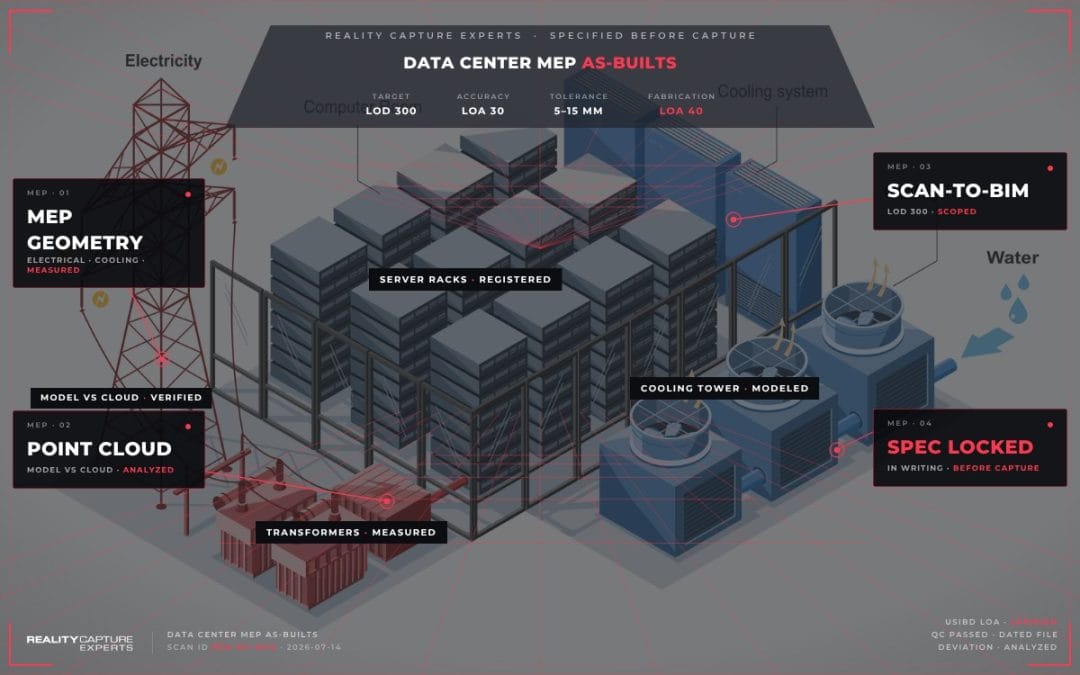
Data center MEP as-builts usually target LOD 300 geometry at LOA 30 accuracy, roughly a 5 to 15 millimeter tolerance, which supports coordination and clash detection. Precision fabrication steps up to LOA 40 (about 1 to 5 millimeters). The most important move is agreeing the spec before capture, because misaligned expectations are the leading cause of scan-to-BIM disputes.
LOD and LOA get used loosely, and that is where data center MEP as-builts go wrong. This guide separates the two and shows what to lock down before a field team arrives. Jake, our AEC specialist and a licensed architect, reviews this guidance. It builds on our pillar on reality capture for data centers.
What is the difference between LOD and LOA for data center MEP as-builts?
They answer two different questions. Level of Development (LOD) describes how much detail and design intent a model element carries. Level of Accuracy (LOA), defined under the USIBD standard, describes how closely the model matches the real, measured condition. You can have a highly developed model that is not measured accurately, and a very accurate point cloud modeled to no particular LOD. Data center MEP as-builts need both defined.
What do the LOA thresholds mean?
USIBD LOA thresholds are commonly cited as LOA 20 (roughly 15 millimeters to 5 centimeters), LOA 30 (roughly 5 to 15 millimeters), and LOA 40 (roughly 1 to 5 millimeters). Higher LOA means tighter tolerance, more scan positions, and more processing. Specifying more accuracy than the use needs adds cost without adding value.
What LOD fits data center MEP as-builts?
LOD 300 is the common target for coordination work, where existing conditions drive the design of new work. At LOD 300, elements carry accurate geometry, correct dimensions, specific types, and true as-built location. For conduit, cable tray, cooling distribution, and electrical gear, LOD 300 is usually the level that lets teams coordinate and detect clashes with confidence in tools like Autodesk Revit. Raise specific elements to LOD 350 only where prefabrication or tight equipment work requires it, rather than paying for the highest level everywhere.
Why the spec must be agreed before capture
Because the scanning provider, the modeling team, and the end user must work to the same target. If field capture density cannot support LOA 30, no amount of modeling recovers it. If the end user expected LOD 350 and the scope said LOD 300, the deliverable feels wrong even though it met spec. RCE locks LOD and LOA in writing before field work, which removes the most common source of rework. Accuracy is then verified against the point cloud in QC, not by eye. The accuracy target also drives the schedule, covered in how long it takes to 3D scan a data center.
Frequently Asked Questions
Is LOD the same as LOA?
No. LOD describes model detail and design intent; LOA describes how closely the model matches the measured condition. Data center MEP as-builts should specify both.
What LOA is right for MEP coordination?
LOA 30, roughly 5 to 15 millimeters, is the common target. Precision fabrication steps up to LOA 40, about 1 to 5 millimeters.
Do I need LOD 400 for a data center?
Usually not for the whole facility. LOD 300 supports most coordination; raise specific elements only where fabrication requires it.
How is accuracy proven?
Through deviation analysis against the point cloud and QC to the USIBD LOA standard.
What Happens Next
RCE sets LOD and LOA for your data center MEP as-builts in scoping and puts it in writing before any field work, plans scan density to support that accuracy, and verifies against the point cloud in QC. Jake reviews the technical scope on AEC-heavy work. For the broader program, see our pillar on reality capture for data centers.