
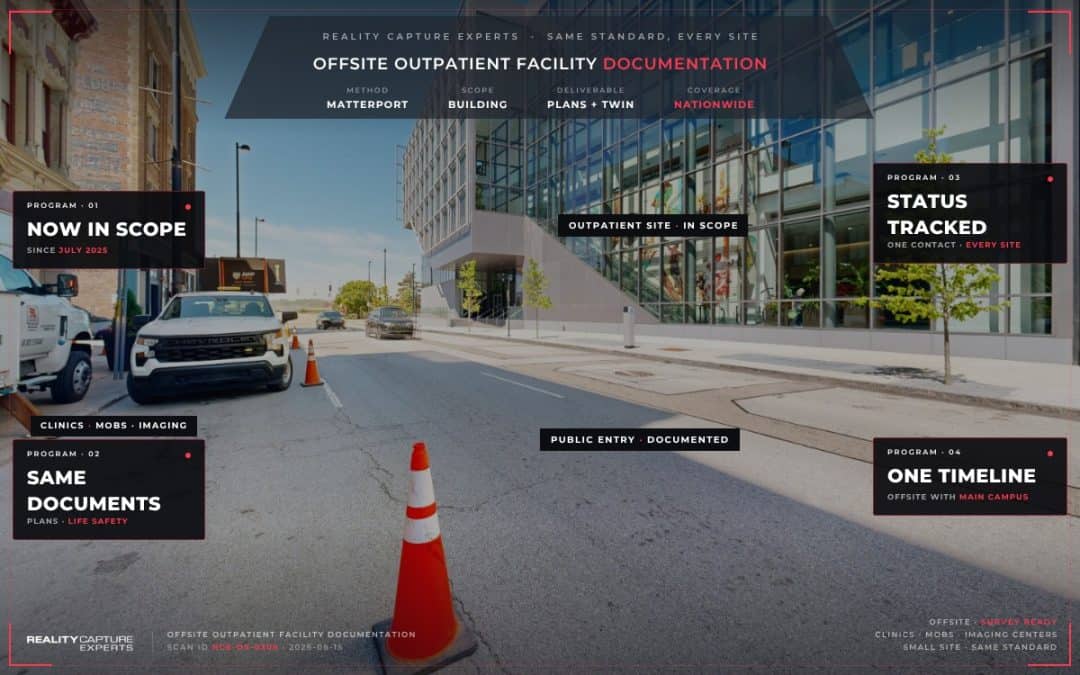
Joint Commission offsite location survey requirements now cover every outpatient and satellite site a health system operates, not just the main hospital campus. You meet them by capturing current floor plans, life safety drawings, and maintenance records for each site, using the same documentation standard applied at the main campus.
What counts as an offsite business occupancy location?
Offsite business occupancy locations generally include medical office buildings, outpatient clinics, imaging centers, and administrative sites that operate under a health system’s hospital license but sit apart from the main campus. These locations were historically reviewed less directly during a survey, which is exactly what recent changes are addressing.
What changed with the July 2025 survey scope expansion?
As of July 1, 2025, Life Safety Surveyors are required to visit a healthcare organization’s offsite business occupancy locations whenever a Clinical Surveyor visits that organization. That pairing means an offsite clinic is no longer likely to be skipped simply because the survey’s main focus is the hospital campus.
For health systems, this shifts documentation planning: an outpatient site that never expected a life safety review now needs the same current drawings and maintenance records as the hospital itself.
What did the Joint Commission announce for 2026 on outpatient life safety compliance?
In early 2026, the Joint Commission announced an increased survey process specifically for Life Safety Code compliance at outpatient facilities. Combined with the July 2025 offsite visit requirement, this signals a sustained shift toward treating outpatient and satellite locations as full participants in life safety survey scope, not secondary sites.
What documentation do offsite locations need?
Offsite locations need the same core documentation as a main hospital campus: current floor plans, life safety drawings showing egress and smoke compartments, and maintenance records for fire alarm and other life safety equipment present at that site. The scale is smaller than a hospital, but the documentation standard is not.
Why is this especially hard for health systems with many outpatient sites?
A health system with a single hospital and a handful of clinics can often manage offsite documentation with the same team that handles the main campus. A system with dozens or hundreds of outpatient locations across multiple states faces a much larger coordination task, tracking which sites have current documentation, which are due for updated capture, and which vendor last touched each site’s drawings.
Where a self-serve capture approach leaves each clinic scheduling its own scan through its own local vendor, documentation format, accuracy, and even file organization end up inconsistent from site to site, exactly the kind of variability that becomes visible once offsite locations are part of routine survey scope.
How does RCE extend survey documentation to every offsite location?
RCE manages offsite location documentation as part of the same nationwide, centralized program used for main hospital campuses. A single point of contact tracks documentation status across every site, schedules a trained operator network to capture outpatient locations on the same timeline as larger facilities, and applies the same QC process regardless of site size.
That means an outpatient imaging center in a health system’s network gets a floor plan and life safety drawing built to the same standard as the flagship hospital, delivered on a timeline that accounts for the expanded survey scope.
Frequently Asked Questions
Do outpatient clinics need the same documentation as a hospital for Joint Commission compliance?
Yes, at the scale relevant to that site. Offsite locations need current floor plans, life safety drawings, and maintenance records, built to the same accuracy standard as a hospital campus, even though the building itself is smaller.
Why do offsite locations matter more for surveys now than they used to?
Since July 1, 2025, Life Safety Surveyors visit offsite business occupancy locations whenever a Clinical Surveyor visits the organization, and the Joint Commission announced an increased survey process for outpatient Life Safety Code compliance in early 2026. Both changes mean outpatient sites are reviewed more directly than in the past.
How does a health system track documentation status across dozens of outpatient sites?
A centralized tracking approach, where one point of contact monitors documentation currency across every location, works better than leaving each site to manage its own records. RCE maintains this tracking as part of its managed capture program so gaps are identified before a survey window opens.
Can RCE capture offsite locations on the same timeline as a main hospital campus?
Yes. RCE schedules offsite and main campus capture within the same nationwide program, using the same trained operator network and QC process, so smaller outpatient sites are not left behind larger capture projects.
What Happens Next
A health system reviewing offsite documentation typically starts by inventorying every business occupancy location under its license and checking each against current floor plans and life safety drawings. RCE scopes that inventory, flags which offsite sites need updated capture given the expanded survey requirements, and schedules a trained operator to each location on a timeline coordinated with the health system’s main campus work. Every deliverable, from a single clinic floor plan to a full campus BIM model, goes through the same QC process before delivery. For the full documentation picture across an entire accreditation program, see What Documentation Do You Need for a Joint Commission Survey? at https://realitycaptureexperts.com/joint-commission-survey-documentation/.