
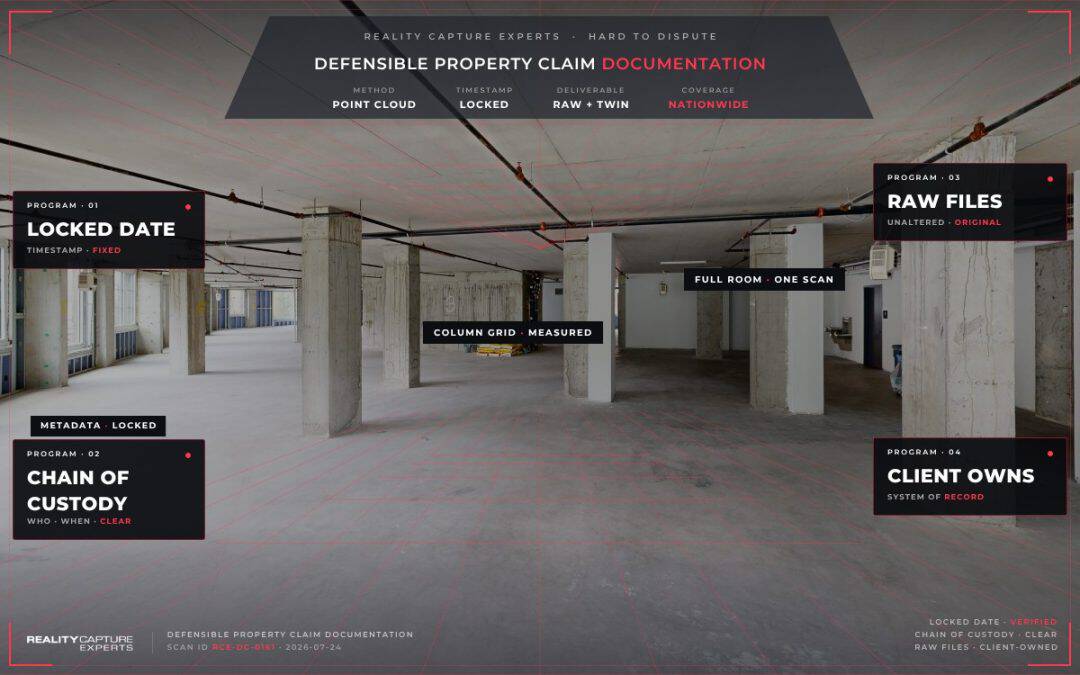
A property documentation chain of custody is the record of who captured a site, when, how the files were handled, and where they were delivered – and it should sit with the client, ideally in a system of record the client controls. Custody matters because a claim reviewer or forensic consultant will ask not just what the documentation shows, but who has had access to it since it was captured.
Why does custody matter separately from the documentation itself?
Because a record’s value depends on trusting that it hasn’t changed since capture. A scan or photo set that passed through unknown hands or unclear storage raises the same doubt as a photo with no date – the content might be accurate, but there’s no way to confirm it wasn’t altered or replaced after the fact.
What does a clear custody record actually include?
Who captured each site and when, what equipment or method was used, where the files were delivered, and who has had access since. RCE documents this as part of standard delivery, rather than leaving it to the client to reconstruct after the fact if a claim gets contested.
Should the client or the vendor hold the files long-term?
The client, in a system of record they control. RCE delivers files directly rather than holding them in a proprietary platform, so there’s no ambiguity about who has had access or whether a third party could have altered anything after delivery.
What happens if a claim reviewer asks for the original, unedited files?
They should be available. RCE delivers the underlying point cloud and imagery, not a processed summary, so a forensic reviewer or adjuster can go back to the raw capture if the claim requires it.
Does custody matter the same way across a multi-site portfolio?
Yes, and it’s harder to keep consistent at scale. When every site delivers to the same system of record under the same logging standard, a risk team can answer a custody question for site 4 the same way they answer it for site 40. A patchwork of local vendors and storage habits makes that consistency much harder to guarantee, since each vendor may log capture details differently or not at all, and files delivered through inconsistent channels are harder to trace back to a single source of truth.
How does a property documentation chain of custody hold up if a claim goes to dispute?
It holds up when the log is complete and the files haven’t moved through hands that aren’t accounted for. A reviewer comparing timestamps, delivery records, and access logs is looking for gaps – any point where it’s unclear who had the file or what they could have done to it. A documented chain with no gaps gives a claim team a straightforward answer instead of an open question.
Frequently Asked Questions
Does RCE retain a copy of captured files after delivery?
RCE delivers files to the client’s system of record; retention policy on RCE’s side is scoped with the client as part of onboarding.
What if a file needs to be shared with a public adjuster or attorney?
The client controls access to their own system of record, so sharing with a third party is the client’s decision, not something RCE gates.
Can custody documentation be provided after the fact if we didn’t ask for it upfront?
RCE logs capture details as standard practice, so this information is generally available even if it wasn’t specifically requested at the time.
Does a break in custody automatically disqualify documentation from a claim?
Not automatically, but it weakens the record’s weight. A clear, unbroken custody trail is what makes documentation hold up without extra argument.
What Happens Next
RCE’s delivery process logs who captured each site, when, and where the files were handed off, before the client ever needs it for a claim. Files go directly to the client’s system of record, so custody stays clear and traceable from the moment of capture forward.
This is part of a broader practice covered in how to build a pre-loss documentation program across a multi-site portfolio.