
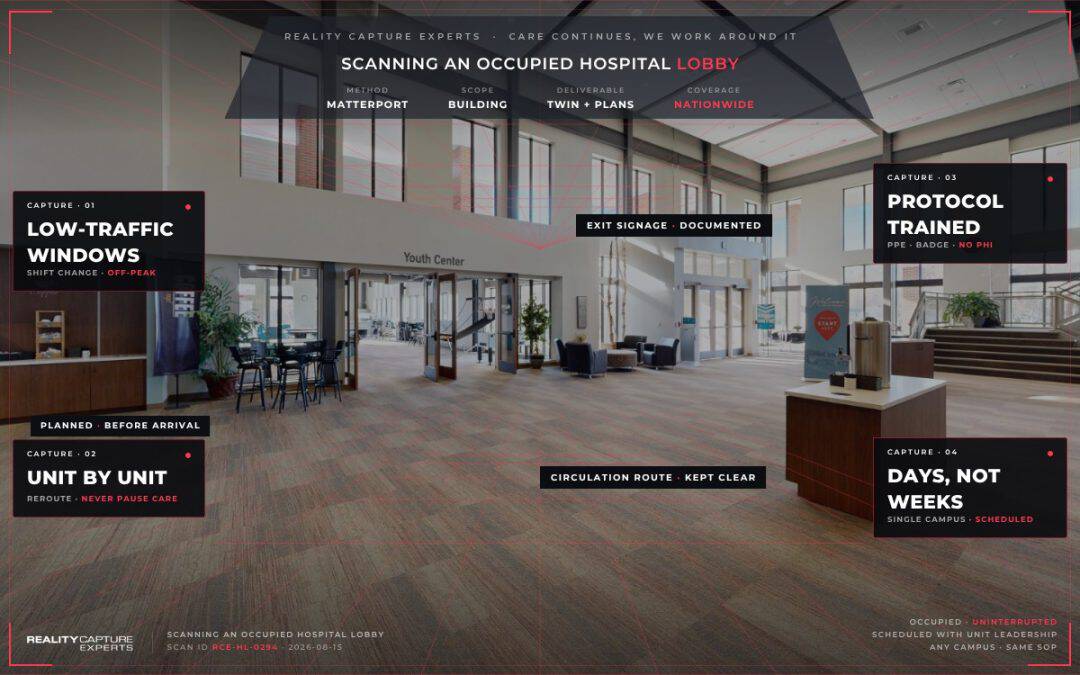
You scan a hospital without disrupting patient care by scheduling capture around clinical operations, using operators trained in hospital protocol, and moving through low traffic windows unit by unit rather than treating the building like an empty commercial space. A managed capture program plans this timeline with facilities staff before anyone arrives on site.
What makes scanning an occupied hospital different from an empty building?
An occupied hospital has patients, staff, and equipment moving through the same corridors an operator needs to capture, and infection control, noise, and privacy rules that do not apply to a vacant office building. Capture has to work around live clinical activity instead of the other way around.
How does RCE schedule capture around clinical operations?
Before any operator arrives on site, RCE’s project management team works with facilities and unit leadership to build a capture schedule around shift changes, procedure times, and known low traffic windows. That schedule gets confirmed with the facility’s point of contact ahead of time, so unit staff know when and where capture will happen.
This planning step is where a centralized, managed program differs most from a self-serve capture approach. A single site scheduling its own scan may not know which hours actually work for its own clinical staff, while a coordinated program builds that knowledge into the timeline from the start.
What safety and privacy protocols apply on-site?
Operators follow the facility’s infection control requirements, including any PPE or badge access rules, and avoid capturing patients, visible patient information, or protected health information in any image or scan. In active clinical areas, capture pauses or reroutes if a patient care activity is underway, and resumes once the area is clear.
How long does it take to scan a hospital campus?
Capture time depends on square footage, number of floors, and how much of the campus needs updated documentation, but most single building hospital campuses can be captured in a matter of days rather than weeks when scheduled around clinical activity. A multi-building or multi-campus system requires a longer coordinated timeline, which is where centralized scheduling across sites keeps a large program from stalling out one facility at a time.
How does RCE coordinate multi-site hospital scanning nationwide?
For a health system with locations across several states, RCE assigns one point of contact to manage the overall project timeline while a trained operator network handles capture site by site. Every site follows the same SOP for scheduling, safety protocol, and QC, so a hospital in one region gets the same process and the same deliverable quality as a hospital in another.
Frequently Asked Questions
Does scanning a hospital require the building to close units or clear patients?
No. Capture is scheduled around existing clinical activity and typically moves through low traffic windows unit by unit, so patient care continues without interruption. Operators reroute around active procedures rather than requiring units to pause.
What happens if an operator encounters a patient or PHI during capture?
Operators are trained to avoid capturing patients, visible patient information, or protected health information, and pause or reroute if an area is active. Any deliverable is reviewed during QC before it reaches the health system.
How far in advance does hospital scan scheduling need to start?
Scheduling typically begins several weeks ahead of the on-site capture date so facilities and unit leadership can confirm timing around shift changes and procedures. Larger multi-building campuses need more lead time to coordinate across departments.
Can a health system schedule scanning across multiple hospitals at once?
Yes. RCE runs multi-site scheduling through a single point of contact, so a health system with several hospitals can coordinate capture timing, safety protocol, and deliverable format across every location under one project timeline rather than negotiating each site separately.
What Happens Next
A facility considering a capture project usually starts with a scope call to confirm square footage, number of units, and any known scheduling constraints tied to clinical operations. RCE builds a capture timeline from that scope, confirms it with facility and unit leadership, and deploys operators according to that agreed schedule. Deliverables, including floor plans and the Matterport digital twin, go through QC before delivery to the facilities team. For the documentation this capture ultimately supports, see What Documentation Do You Need for a Joint Commission Survey? at https://realitycaptureexperts.com/joint-commission-survey-documentation/.