
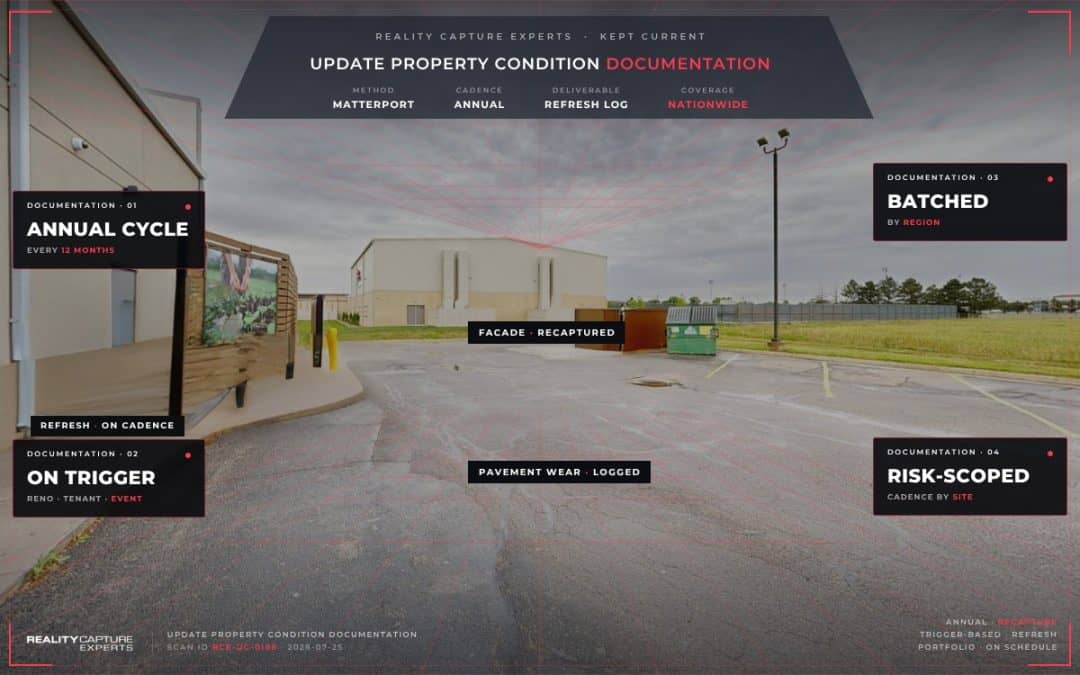
Update property condition documentation every two to three years for standard sites, with an additional recapture any time a site goes through a major renovation, tenant change, or capital project. Waiting past that window leaves a portfolio’s baseline stale right when it’s needed most, since tenant improvements, deferred maintenance, and ordinary wear have had years to move a property away from what the original scan shows.
Why does documentation go stale?
Buildings change constantly – tenant improvements, deferred maintenance, wear, and small repairs all shift a property’s actual condition away from what an old scan shows. Most property condition documentation stays reliable for two to three years; beyond that window, it may no longer reflect current reality closely enough to be useful in a dispute.
What triggers an out-of-cycle recapture?
Major renovations, a new tenant build-out, a capital project, storm damage even if no claim was filed, or a change in property use are all reasons to recapture outside the standard cycle. Any event that changes the building’s physical condition should reset the documentation clock for that site, regardless of where it sits in the standard two-to-three-year rotation.
What documentation format holds up best over a multi-year refresh cycle?
A dated point cloud and measured floor plan hold up better than photos alone, because the underlying geometry stays useful even years later – you can still pull a dimension or check a specific area long after the fact. A folder of photos ages the same way a memory does: useful right after capture, harder to rely on as time passes and no one remembers exactly what each image was documenting.
How does a multi-site portfolio manage recapture scheduling without it becoming a burden?
By treating it as a standing, coordinated calendar rather than a site-by-site reminder system. RCE schedules recapture on a two-to-three-year rotation, batching sites by region, so a portfolio’s documentation refresh happens on a predictable calendar instead of falling to individual property managers to remember and separately coordinate.
Does a more frequent recapture cadence cost more than it’s worth?
For high-value or high-risk sites, a shorter cycle – often annual – is worth the cost relative to the risk of a disputed claim with stale documentation. For lower-risk, stable sites, the standard two-to-three-year cycle is typically sufficient. RCE scopes cadence by site risk profile rather than applying one blanket schedule to an entire portfolio.
How does update property condition documentation fit into a portfolio’s overall risk program?
Update property condition documentation on a set cadence and it becomes a standing input to the same risk program that handles pre-loss surveys, defensible claim records, and post-loss capture. Treated together, these practices give a portfolio a consistent, dated documentation posture rather than four disconnected efforts running on different schedules.
Frequently Asked Questions
Is annual recapture required for every site in a portfolio?
No – the standard baseline is every two to three years, though higher-risk or higher-value sites are often recaptured more frequently.
What counts as a “major” renovation that triggers recapture?
Generally any project that changes structural elements, major systems, or a significant portion of finished space.
Can RCE track recapture scheduling automatically?
RCE builds a recapture calendar during portfolio onboarding and coordinates scheduling with the client’s team as part of the managed service.
Does recapture replace the original pre-loss baseline, or add to it?
It updates the record for that site going forward; the prior capture remains part of the property’s documentation history.
What Happens Next
RCE builds a recapture calendar as part of the initial portfolio scoping, batching sites by region and risk profile so refresh cycles land on a two-to-three-year rotation without manual tracking by the client. When a site reports a triggering event – renovation, tenant change, capital project – RCE schedules an out-of-cycle recapture and updates that site’s documentation record.
This closes out this week’s series on documentation that holds up. For the foundational baseline this builds on, see how to build a pre-loss documentation program across a multi-site portfolio.