
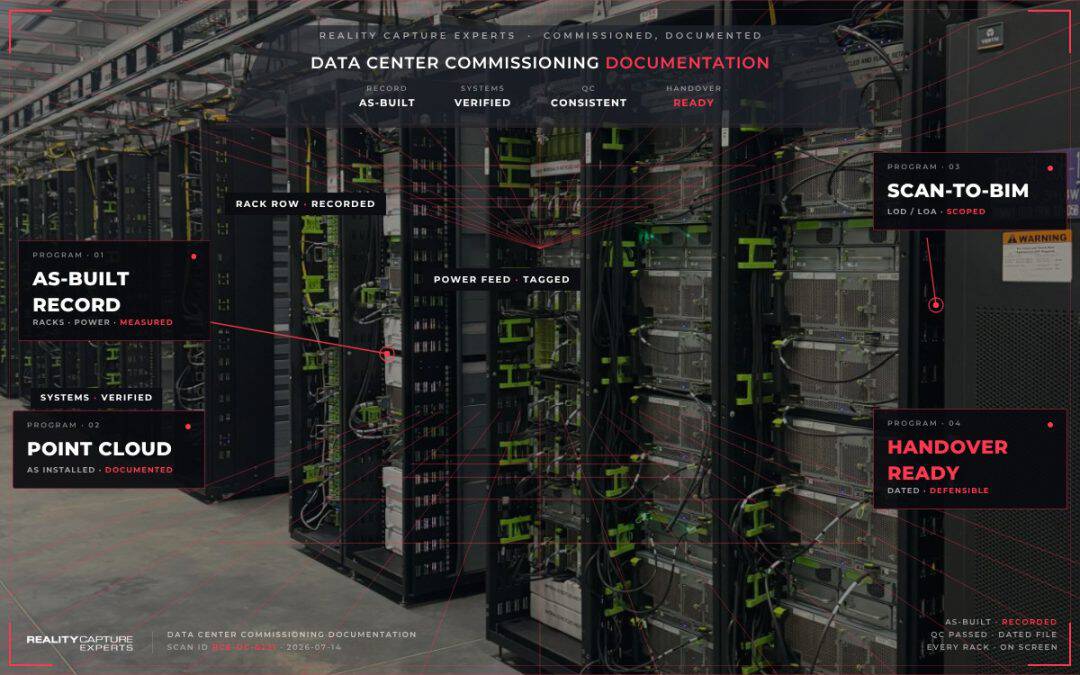
Data center commissioning documentation gives every team a verifiable record of what was actually installed, so functional testing, integrated testing, and operational readiness are checked against reality instead of design drawings that changed in the field. It also protects the construction-to-operations handoff, where owners expect a complete, organized, and traceable record.
Commissioning is one of the most demanding parts of data center delivery, and it runs on documentation. This guide shows where accurate as-builts fit in the commissioning sequence, and why data center commissioning documentation is worth the effort when delays are so costly. It extends our pillar on reality capture for data centers.
Why data center commissioning documentation is so central
Commissioning verifies that electrical, mechanical, controls, and integrated systems work under load and failure scenarios, and that verification is only as good as the record it is checked against. Structured documentation provides evidence at each phase: planning validation, installation verification, functional testing, integrated testing, and operational readiness. When the as-built does not match the field, teams reconcile paperwork instead of verifying systems, and the schedule slips. On a typical 60 MW facility tracked by industry reporting, a commissioning delay can cost a developer roughly $14.2 million per month.
How as-built capture fits the commissioning sequence
It fits at the transitions. Reality capture records what is actually installed before walls close, before systems are energized, and at turnover. Capturing before concealment matters most: once conduit, piping, and cabling are behind walls or above hard ceilings, the only affordable record of their real routing is the one captured while they were exposed. The accuracy that verification needs is the LOD and LOA question covered in data center MEP as-builts.
Why the handoff to operations depends on it
The documentation produced during construction becomes the facility’s operational record. As-built MEP drawings, commissioning test reports, and material certifications carry into operations, and teams that follow Uptime Institute operations practices expect them complete, organized, and traceable. A clean handoff means the operations team starts from a reference that matches the building. Keeping that record consistent across sites is covered in multi-site data center documentation.
Frequently Asked Questions
When should as-built capture happen during construction?
At key transitions, and critically before systems are concealed, so the real routing is preserved for commissioning and future maintenance.
Does data center commissioning documentation speed up commissioning?
It removes reconciliation work. When the record matches the field, teams verify systems instead of chasing outdated drawings.
What does a commissioning delay cost?
On a typical 60 MW facility, roughly $14.2 million per month in lost revenue and related impacts.
What documentation carries into operations?
As-built MEP drawings, commissioning test reports, and material certifications.
What Happens Next
RCE plans capture around the commissioning schedule, coordinating reality capture at the phases that matter, before concealment, at energization, and at turnover, and delivers a navigable Matterport record plus a measured point cloud where verification requires it. The output drops cleanly into your data center commissioning documentation at handoff. For the full program, see our pillar on reality capture for data centers.