
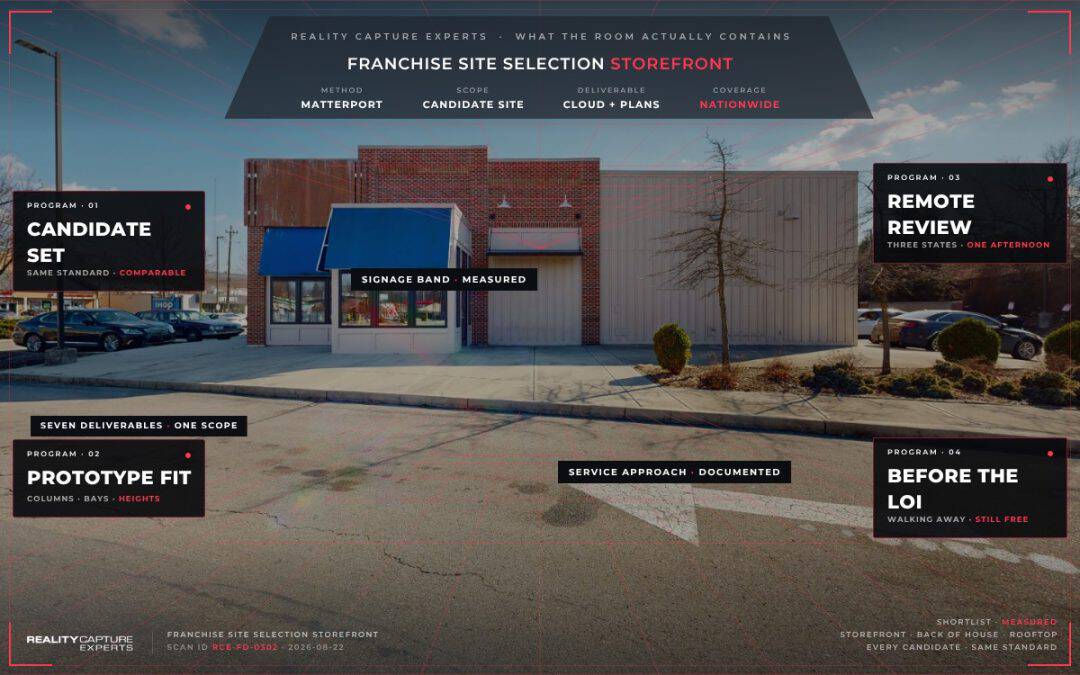
Franchise site selection should include measured existing conditions, not just demographics and rent. Before the letter of intent, capture the space so the prototype layout can be tested against real dimensions, the storefront can be reviewed remotely, and the build-out scope can be priced from something other than a guess.
Key takeaways
- Most site selection work stops at trade area and rent, and skips the physical building entirely.
- A remote walkthrough lets a franchisor compare candidate sites in different states in one afternoon.
- Prototype fit is a dimensional question, and it can be answered before an architect is engaged.
- The letter of intent is the last point where walking away is cheap.
What does traditional site selection actually cover?
Demographics, traffic counts, co-tenancy, visibility, rent, and term. All of it necessary, and all of it about the trade area rather than the building.
The physical space usually enters the process as a square footage figure and a handful of photos. That is enough to shortlist. It is not enough to commit.
The gap shows up later. The prototype, meaning the standard layout and equipment package the brand has designed, turns out not to fit the column spacing. The grease interceptor is not where anyone assumed. Ceiling height fails in the one bay that needed the hood. None of that is visible in a flyer.
How does a remote walkthrough change the comparison?
A 3D capture produces a navigable model anyone can move through from a browser. For a franchisor weighing three candidate sites in three states, that means comparing all three in an afternoon rather than booking three trips.
It also changes who gets to look. The construction lead, the brand standards reviewer, the equipment supplier, and the franchisee can all walk the same space independently, take their own measurements, and mark what concerns them. Matterport supports tags placed directly in the model, so a note about a column or a low soffit stays attached to the spot it refers to.
The practical effect is fewer decisions made on somebody’s recollection of a visit.
How do you test whether the prototype fits?
By overlaying the prototype layout on measured plans rather than on a sketch.
The same capture produces schematic floor plans, which are dimensioned drawings of the space as it exists. With those, the layout can be tested against real column positions, real bay widths, and real ceiling heights before an architect is engaged and before a lease is signed.
This is where a lot of deals quietly get better. Either the prototype fits and everyone proceeds with confidence, or it does not and the deal gets renegotiated, adjusted, or dropped while dropping it is still free.
What should be captured on a site visit?
More than the sales floor. The parts that drive cost tend to be the parts nobody photographs.
The full tenant space including back of house, storage, and restrooms. Ceiling conditions above any dropped ceiling, since that is where existing mechanical, electrical, and plumbing runs. The service and delivery approach. The storefront and any signage band. Rooftop equipment where access allows.
Background on the full deliverable set in how to document a franchise site before build-out.
Frequently Asked Questions
Is it worth capturing a site we might not take?
For a shortlist, usually yes. The cost of capturing three candidates is small against one bad lease, and the two you decline are documented if they come back on the market.
Can this be done while the previous tenant is still operating?
Yes. Capture is scheduled around trading hours and nothing is moved. An occupied space produces a busier walkthrough, but measured plans are still produced.
Does a capture replace a professional site survey?
No. It gives reference-grade existing conditions for design and scoping decisions. Where survey-grade tolerances are required, that stays a surveyor’s job and the two work together.
How quickly can a site be captured once we have access?
Usually within a few days of access being confirmed, since RCE coordinates technicians nationwide rather than routing one team between markets.
What Happens Next
Send us the shortlist. We capture each candidate site to the same standard so they can be compared honestly, and deliver walkthroughs the whole review team can open plus measured plans the prototype can be tested against. For a rollout, the standard is set once and applied in every market.