
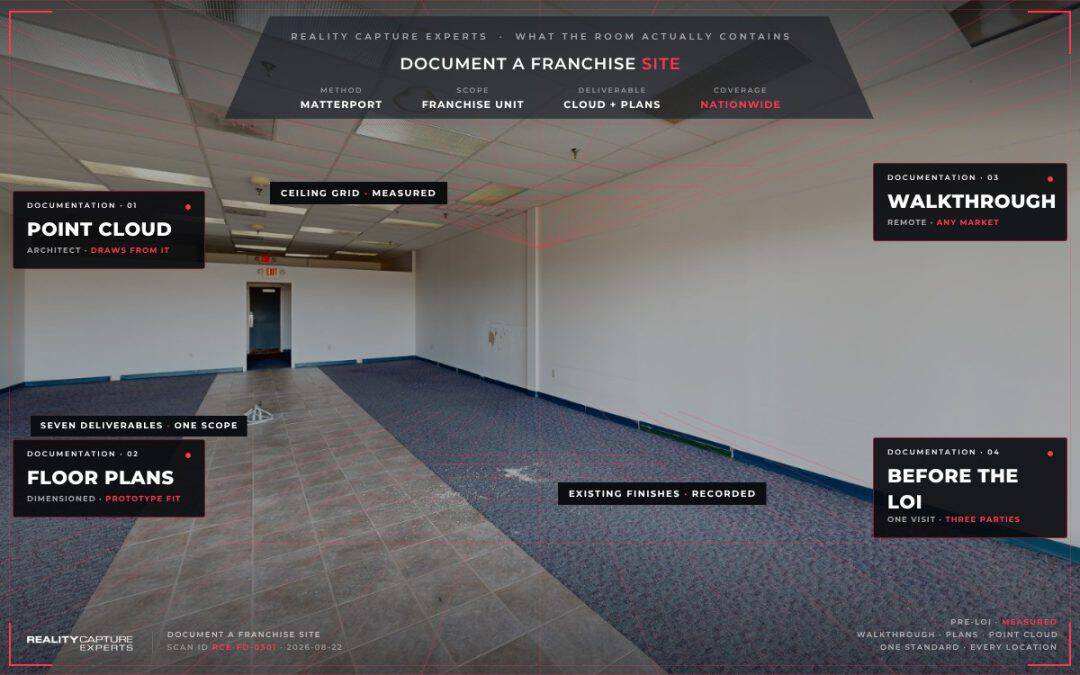
Document a franchise site by capturing it once, before the letter of intent is signed, in a form all three parties can use. A single 3D capture produces a walkthrough for remote review, dimensioned floor plans for feasibility, and a point cloud the architect draws from. One visit, three deliverables, no second trip.
Key takeaways
- The construction team, the franchisor, and the new owner all need the same site facts, and usually work from different records.
- Capturing before the letter of intent is signed puts real conditions into the decision instead of after it.
- One capture yields three things: a remote walkthrough, dimensioned plans, and a point cloud for the architect.
- Across a rollout, one capture standard is what makes location twelve comparable to location one.
Who actually needs the site documented?
Three parties, with three different questions, looking at the same room.
The national construction team asks what it will take to build. They are managing openings across many markets at once and cannot walk every prospective space themselves. What they need is enough measured detail to scope the work and price it before committing.
The franchisor asks whether this location protects the brand. Can the prototype fit, meaning the standard layout and equipment package the brand has designed for. Does the storefront work. Is this space close enough to the standard that the location will look and operate like every other one.
The new owner asks what they are signing up for. This is usually their first build-out. They have walked the space once, with a broker, for twenty minutes.
Why does the letter of intent matter as a deadline?
A letter of intent, usually shortened to LOI, is the non-binding document that sets the basic deal terms before lawyers draft a lease. It is the last comfortable moment to walk away.
Most site information gathered before an LOI is a broker flyer, a rough square footage number, and photos taken on a phone. Those are enough to like a space. They are not enough to know whether the prototype fits, where the existing plumbing sits, or how much of the mechanical work the landlord has already done.
Documenting before the LOI moves that discovery earlier, while there is still time to act on what turns up.
More on comparing candidate sites in what franchise site selection should include before you sign.
What does one capture actually produce?
A single Matterport capture of a prospective space produces three usable outputs, and this is the part most people underestimate.
A navigable walkthrough. Anyone with a link can move through the space, look up at the ceiling, and measure a wall, from anywhere. For a franchisor evaluating three candidate sites in three states, this replaces three flights.
Dimensioned floor plans. Matterport produces schematic floor plans from the same capture, which is enough to test whether the prototype layout fits before anyone pays an architect to try.
A point cloud. A point cloud is a dense set of measured points describing the real geometry of the space, and it is what an architect imports to draw accurate existing conditions. Matterport delivers this through MatterPak, its file bundle, or as an E57 file, a vendor-neutral point cloud format that opens in Revit and AutoCAD.
More on that last one in how point cloud data becomes a Revit model or CAD drawing.
Why does this get harder across a rollout?
One location is a project. Forty locations opening over two years is a program, and the difference is consistency rather than equipment.
The usual pattern is that each market gets handled locally. A different scanning vendor per region, a different file format, a different naming convention, a different level of detail. Individually each is fine. Together they mean the construction team cannot compare site nine to site twenty-two without redoing work.
RCE runs it the other way. One scope of work, one capture standard, one QC process, one point of contact, applied at every location regardless of who holds the camera. The construction team approves the standard once instead of renegotiating it in every market.
Related: how to capture franchise locations to the same standard.
How does RCE scope a franchise capture program?
Four steps, and the first two happen before anyone books travel.
Scope call. What decisions the documentation has to support. Site comparison, prototype fit testing, and architect handoff each need a slightly different deliverable set.
Deliverable agreement. Which outputs, at what level of detail, in which file formats, named how. Written once and applied to every site in the program.
Access and scheduling. Broker access, landlord permission, and whether the space is occupied by the previous tenant. This is what sets the calendar.
Capture and QC. A technician captures to the agreed standard, coverage is checked against the plan before the site is released, and deliverables arrive in the agreed formats.
Capture is not only a pre-lease activity. On when to come back once work is underway, see when to scan during construction on a franchise build-out.
Frequently Asked Questions
When in the franchise process should a site be captured?
Before the letter of intent is signed, where it can still change the decision. A second capture after demolition is common on larger build-outs, because it reveals what was behind the walls.
Does the space need to be empty?
No. Occupied spaces are captured regularly. A previous tenant’s fixtures make the walkthrough busier, but measured geometry and floor plans are still produced. If the tenant is still trading, capture is scheduled outside business hours.
Who typically pays for the capture, the franchisor or the franchisee?
Both models are common. Franchisors running a managed program often fund capture centrally so the standard stays consistent across every location. Individual franchisees also commission capture directly.
How long does capture take for a typical franchise unit?
A retail or restaurant unit under 5,000 square feet is usually a single visit of a few hours. Deliverables follow, with timing confirmed in the scope of work.
Can one capture serve all three parties?
That is the point of doing it once. The same capture produces the walkthrough the franchisor reviews, the plans the construction team scopes from, and the point cloud the architect draws from.
What Happens Next
If you are evaluating sites for a franchisee right now, the useful first step is a scope call rather than a scan. We work out which of the three parties needs what, agree the deliverable list, and set one standard your whole rollout runs on.
You get one point of contact for every market, and the documentation from location twelve reads the same as the documentation from location one.