
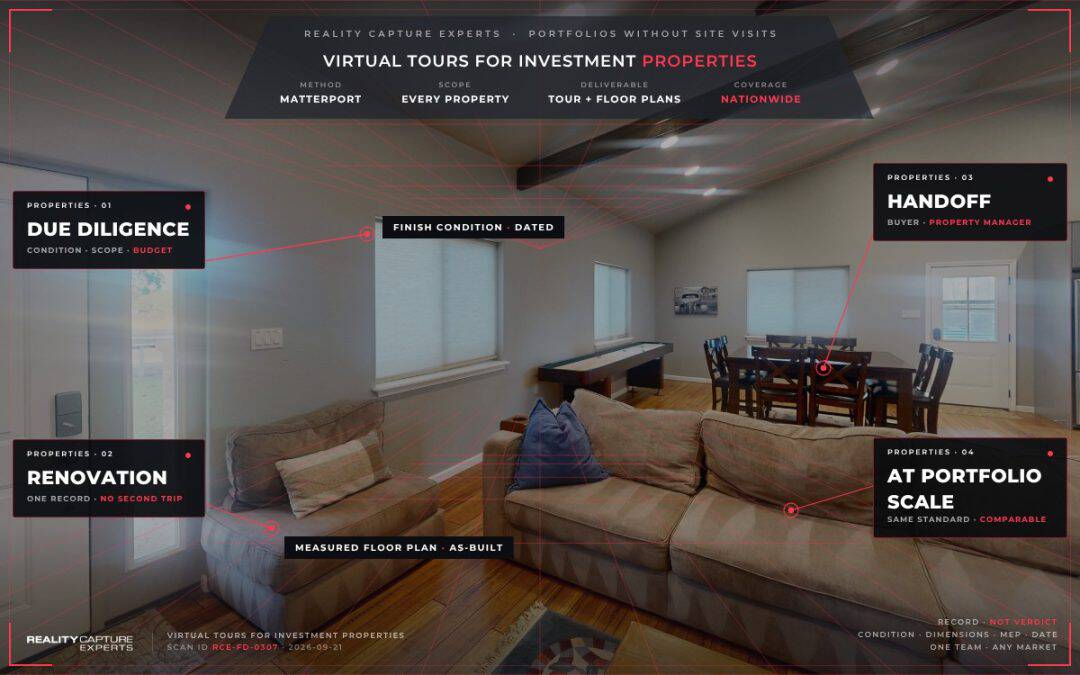
Virtual tours for investment properties give remote investors a measurable record of a building they cannot walk. They serve three moments: assessing condition and renovation scope before close, keeping architects and contractors aligned during work, and handing a complete as-built record to a buyer or property manager at the end.
For a buyer’s view of how to get the most from a tour, see Redfin’s guide, Using Virtual Tours to Narrow Your Home Search, which features insights from Reality Capture Experts.
Why do portfolio investors buy sight unseen?
Buying remotely is no longer unusual. Roughly one in five homebuyers made an offer sight unseen in 2025, up from about three percent in 2019. For investors the share is higher still, because the math works across geography and the best deals are rarely in your own backyard.
A developer in California acquires a multifamily building in Tennessee. A hospitality investor in New York closes on a renovated inn in Colorado. An entrepreneur coordinates a flip across two states with an architect who lives in a third. The property manager, the design team, and the contractor may all be in different cities.
The investor’s job is not to be on site. The investor’s job is to see the property. Missing a site visit is not the risk. Making decisions without seeing what you bought is.
What are the three moments you need a virtual tour?
Due diligence before close. The investor and the lender both need to assess condition, estimate repair scope, and understand the renovation budget. A property inspection answers part of that. A measurable 3D record answers more, because an architect can take dimensions from the data and a contractor can read existing conditions without a site visit of their own.
Renovation coordination across distance. Once work starts, the architect needs to confirm the contractor is following scope. The designer needs to see finishes before making selections. The investor needs evidence that work is progressing without flying out to check. Repeat site visits compound cost and delay. One captured record every stakeholder can reference does not.
Buyer or manager handoff. Before the investor sells or hands off to a property manager, the incoming operator needs to know what they are inheriting. Systems, finishes, condition, and measurements. A capture is that handoff package.
What does a virtual tour actually record?
The useful version of this deliverable is more than a walkthrough video. A capture built for investment decisions produces:
- A navigable 3D record of every accessible room, with dimensions measurable after the fact
- Measured floor plans reflecting as-built conditions rather than listing drawings or old plans
- Visible condition detail on finishes, ceilings, flooring, and building envelope
- Mechanical, electrical, and plumbing equipment recorded in position, with nameplate detail where accessible
- A dated record, so the state of the property at a known moment is fixed rather than remembered
That last point carries more weight than investors expect. When a dispute arrives, the question is almost never what the building looks like now. It is what it looked like then.
What does missing information actually cost?
A property manager arrives at a newly renovated property and finds finishes that do not match the agreement. Dispute, then rework or a cost negotiation. A contractor starts work and discovers the site plan does not match the existing building. Schedule slip and a change order. A designer specifies appliances from old drawings and they do not fit. Delivery delay.
All three start the same way. The investor and the remote team do not picture the property the same way, and every decision built on that mismatch inherits it.
A virtual tour is not a guarantee. It is a common reference. When every stakeholder sees the same property at the same moment in measurable detail, the number of surprises drops.
What does a virtual tour not replace?
Being straight about this matters, because overselling it is how investors get burned.
A capture does not tell you how the floor feels underfoot, what the HVAC sounds like under load, or whether there is moisture behind a wall. It does not replace a licensed inspector, a structural engineer, or an environmental assessment. It does not see inside closed assemblies.
What it does is give those professionals, and everyone downstream of them, a shared and measurable baseline to work from. It is supporting evidence that multiple parties can review without anyone returning to site. Treat it as the record, not the verdict. More on where that line sits in remote property inspection and due diligence.
How are multi-property investors using this at scale?
An investor with ten properties captures all of them to the same standard. When an architect quotes a renovation, they work from the capture instead of a site visit. When a property manager is hired, they get a tour before their first day. When a lender needs proof of condition before a refinance, the documentation already exists. The cost of capturing all ten pays back across every decision that follows.
An investor with fifty properties across three states runs a portfolio where every building carries the same documentation standard. That standardization is what makes condition assessments comparable, renovation quotes comparable, and handoff packages comparable. It also means the whole portfolio is reviewable from a desk.
The failure mode at scale is predictable. Properties get captured ad hoc, by whoever was available, at whatever level of detail seemed right that day. The records exist and still cannot be compared. Fixing that after the fact means recapturing. We cover the standards that prevent it in multi-property management documentation.
How does this compare to just flying out?
The honest comparison is not capture against nothing. It is capture against the travel schedule it displaces, and against the decisions that get made when neither happens.
One site visit is one person, one moment, and one set of notes. Whatever that person did not think to photograph is gone. If the architect needs the same information three weeks later, that is a second trip, or more commonly a phone call asking someone on site to go measure something and report back. That is where errors enter.
A capture inverts it. One visit produces a record several people can interrogate independently, at different times, for different reasons, without coordinating calendars. The lender’s question, the architect’s question, and the contractor’s question all get answered from the same visit.
There is a second effect that is harder to price and usually larger. Because reviewing a capture costs nothing, people actually do it. A trip that requires a flight gets deferred, and decisions get made on assumption instead. Removing that friction changes how carefully properties get reviewed, not just how cheaply.
How do you handle occupied properties?
Most investment property is occupied, which makes this the practical question rather than an edge case.
Capture is scheduled around occupancy, with tenants out of frame and notice given per the lease. Any incidental capture of a person is reviewed and removed in post production before delivery. Personal belongings stay in place, since the record is meant to reflect the property as it operates rather than as a staged listing.
Where tenants are present, the coordination burden is real and worth planning for. Notice periods vary by jurisdiction and lease. Access to individual units in a multifamily building may need to be sequenced across several days rather than completed in one visit. This is scheduling work more than capture work, and it is the main reason occupied portfolios take longer in calendar time than the capture hours suggest.
What about properties you already own?
Most of this discusses acquisition, but the larger opportunity for an established investor is usually the existing portfolio.
Properties bought years ago typically have the thinnest documentation, often a listing photo set and whatever the inspector produced at the time. Renovations since then have moved walls the drawings still show. When a refinance, a sale, an insurance renewal, or a manager change arrives, that gap becomes urgent on someone else’s timeline.
Capturing the existing portfolio is not urgent until it suddenly is. The investors who handle it well treat it as a phased backlog, sequenced behind the time-bound work rather than competing with it.
How many properties before this is worth doing?
There is no clean threshold, but the economics shift in a recognizable way. On a single property, a capture competes directly against one plane ticket. On five, it competes against a travel schedule. Past ten, it stops competing with travel at all and starts competing with the cost of decisions made on bad information, which is a much larger number.
The other variable is team geography. An investor whose architect, contractor, and manager are all local gets less from this than one coordinating three cities. Distance is what the record is buying down.
Property type matters too. A single family rental in reasonable condition is a light record. A mixed-use building with commercial tenants, three mechanical systems, and a renovation history nobody documented is where a capture earns its cost several times over, because the alternative is discovering the building in pieces over two years of ownership.
The clearest signal that a portfolio has crossed the threshold is behavioral rather than numerical. When someone on the team starts a sentence with “I think that property has” and nobody can confirm it, the portfolio has outgrown memory. That usually happens earlier than investors expect.
None of this argues for documenting everything immediately. It argues for deciding what the record has to prove before the first capture, because that decision is cheap now and expensive to retrofit across a portfolio you have already photographed inconsistently.
Where does RCE fit?
RCE runs this as a managed program rather than a series of bookings. The investor names a set of properties. RCE sequences them, deploys technicians against one capture scope, applies quality control to every capture before delivery, and returns one consistent record per property under a single naming convention.
The alternative most investors try first is coordinating an operator in each market themselves. That works for two properties and degrades from there, because each market brings a different operator with different habits and nobody is comparing output across markets. One point of contact across every region is the part that does not scale on its own.
What happens next
The first conversation covers which properties matter most, in what sequence, and what the record needs to prove. From there RCE sets a standard capture scope, handles scheduling and access against each property’s constraints, runs quality control with post production notes on every capture, and delivers through one point of contact.
A property list and the date driving the timeline, whether that is a closing, a renovation start, or a refinance, are enough to begin scoping.
For the three angles in detail, read remote property inspection and due diligence, renovation progress documentation, multi-property management documentation, and how to build the workflow.
Frequently Asked Questions
How much does it cost to document one property?
Pricing depends on property size, complexity, and how many properties are in the program. A one-off capture costs more per property than the same property inside a portfolio program. RCE scopes rates per program rather than from a published rate card.
Can properties be captured while tenants are occupying them?
Yes. Capture is scheduled around occupied spaces with tenants out of frame. Any incidental capture of people is reviewed and removed in post production before delivery.
How long does it take to document a property?
A typical residential or small commercial property is usually a few hours on site. Larger or more complex buildings run longer. Calendar time stretches past capture hours because of access windows and escort availability, which is the constraint worth planning around.
Do we need laser scanning, or is a Matterport capture enough?
For condition assessment, renovation coordination, and handoff, a Matterport capture with measured floor plans covers it. LiDAR and point cloud deliverables get added where a design team needs survey level accuracy, and that is usually a subset of properties rather than all of them.
Does a virtual tour satisfy a lender?
It supports a submission rather than replacing an appraisal. Lenders increasingly accept documented, time-stamped condition evidence, and appraisal guidance now contemplates virtual inspection methods, but acceptance varies by lender and loan type. Confirm the format before capture.