
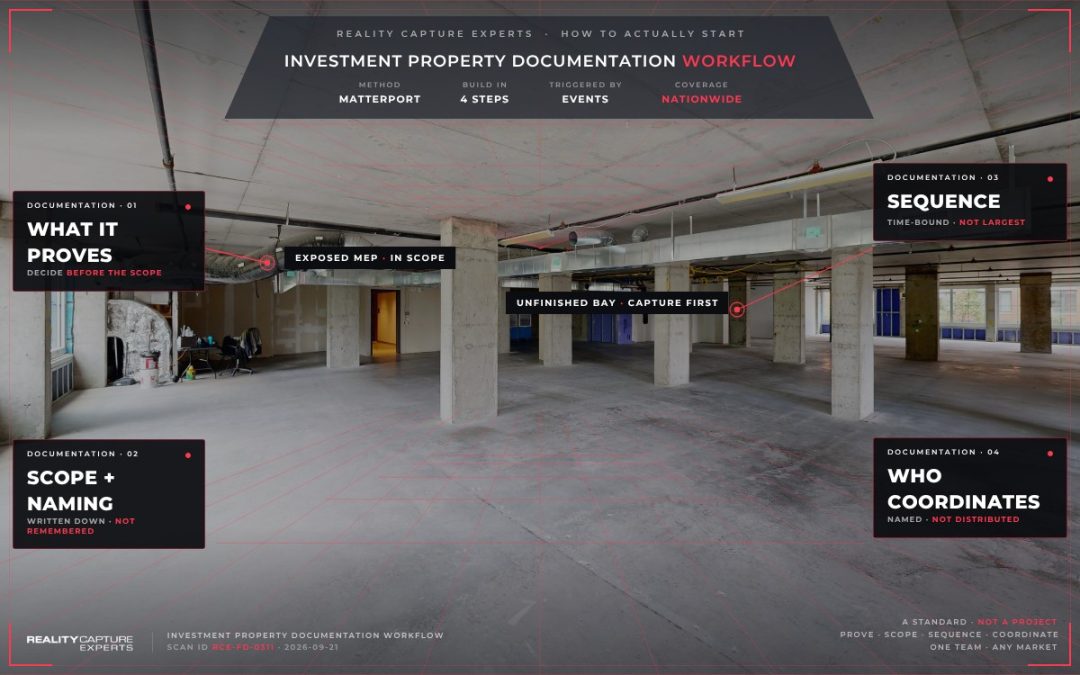
An investment property documentation workflow is the repeatable process that decides what gets captured, when, by whom, and where it is filed. Building one takes four steps: define what the record must prove, set the capture scope and naming convention, sequence the properties, and assign the single point of coordination.
Why do investment property documentation programs stall before they start?
Most investors already agree documentation is worth having. The program stalls anyway, and usually for one of three reasons.
Nobody owns it. Documentation sits between acquisitions, asset management, and construction, and belongs to none of them by default. Work that belongs to everyone gets done by no one.
The scope is undefined, so every property becomes a fresh negotiation about what to capture. That friction is enough to stop a program after three buildings.
It is treated as a project with an end date rather than a standard applied to new acquisitions as they close. Programs framed as one-time catch-up exercises finish and then decay.
Step one: decide what the record has to prove
This decision shapes everything after it, and skipping it is why scopes drift.
A record built for acquisition diligence prioritizes condition, systems, and anything a lender or inspector will question. A record built for renovation prioritizes dimensional accuracy and pre-demolition conditions. A record built for handoff prioritizes finishes, equipment, and completeness. A record built for insurance prioritizes dated evidence and consistent coverage across comparable properties.
One capture can serve all four, but only if the requirements are collected before the scope is written rather than discovered afterward by whichever function was not asked.
Step two: write the scope and the naming convention
The scope is a written list of what a technician captures at a property of each type, including the spaces that are easy to skip: mechanical rooms, electrical panels, attics and crawl spaces where accessible, and exterior elevations.
The naming convention should use the property identifier you already use, not the street address, since addresses get formatted five different ways. Filing practice that holds up at scale puts the property first, then the category, with dates inside the filename.
Write both down. A convention that lives in someone’s head is not a convention.
Step three: sequence the properties
Order by what is time-bound rather than by what is largest. Anything entering renovation should be captured before demolition, because that baseline cannot be recreated. Anything facing a refinance, sale, or insurance renewal should be captured ahead of the submission. Everything else groups by market to compress travel.
Set the standard in phase one regardless of how small phase one is. Sequence is flexible. Standards are not.
Step four: decide who coordinates
Someone has to hold property contacts, operating constraints, access requirements, and the schedule across every market. In practice this is either an internal coordinator who takes it on as a named responsibility, or a managed provider who takes it on as the service.
What does not work is leaving it distributed. Distributed coordination is how a portfolio ends up with fifteen captured properties, four conventions, and no one able to say which buildings are covered.
What do the first 90 days look like?
A workflow that exists only on paper is the most common outcome, so it helps to know what the first quarter should actually produce.
Weeks one and two. The four decisions get made and written down: what the record proves, the capture scope per property type, the naming convention, and who coordinates. This is one working session plus a round of edits, not a project.
Weeks three to six. Capture the first small group, ideally three to five properties chosen because something time-bound is driving them. This is the pilot, and its purpose is to test the scope against reality. Expect to revise it once. A scope that survives first contact unchanged usually means nobody checked it.
Weeks seven to ten. Revise the scope and the convention based on what the pilot surfaced, then lock both. This is the step most programs skip, and skipping it is why the standard drifts by property twenty.
Weeks eleven to thirteen. Attach capture to the trigger events, so new acquisitions and renovations start flowing through automatically, and set the backlog sequence for everything already owned.
How do you keep the workflow running after the catch-up phase?
The programs that survive attach capture to events that already happen rather than to a calendar. Capture at acquisition close. Capture before demolition. Capture at substantial completion. Capture at manager turnover.
Tied to events, documentation becomes a step in processes you already run. Tied to a calendar, it becomes a recurring task that competes with everything else and eventually loses.
The standards that keep the output comparable as this runs are in multi-property management documentation.
What happens next
RCE builds the workflow with the investor rather than handing over a template. Scoping covers what the record must prove, the capture scope per property type, the naming convention, the sequence, and the trigger events that keep it running after catch-up. From there RCE coordinates scheduling across markets, applies quality control to every capture, and delivers through one point of contact.
A property list, the property types in it, and the events that should trigger capture are enough to start. For the full picture, see virtual tours for investment properties, and for evaluating properties before you own them, remote property inspection and due diligence.
Frequently asked questions
How long does it take to stand up a workflow?
The decisions take one working session. Capturing the existing portfolio takes as long as the sequence and access allow. The decisions are the part worth not rushing.
Should we capture the whole portfolio before setting the standard?
No. That is the most expensive order of operations, because properties captured before the standard exists usually need recapturing. Set the scope and naming on the first few, then scale.
What if we already use property management software?
Keep it. The capture record is a deliverable that gets filed and linked, not a replacement for your management system. The naming convention should match how that system already identifies properties.
Who should own documentation internally?
Whoever owns the outcome it serves most. Acquisition-driven programs usually sit with asset management, renovation-driven programs with construction. What matters is that it is named rather than assumed.