
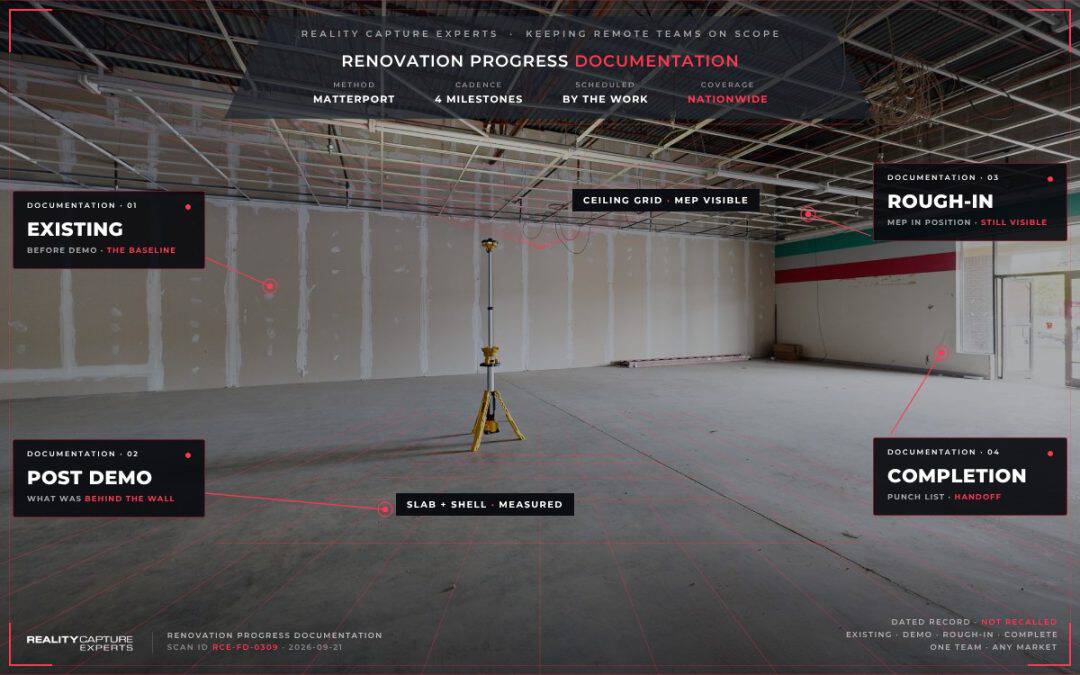
Renovation progress documentation is a dated visual and dimensional record captured at defined milestones during construction. It lets an architect confirm work matches design, a contractor evidence what was completed, and a remote investor verify progress without a site visit, all from the same reference.
Why does remote renovation oversight break down?
The pattern is consistent. Work starts, the investor is two states away, and the only progress signal is a contractor’s text with three photos attached. Those photos are chosen by the person being reviewed, framed to show what is finished, and impossible to measure.
Nobody is being dishonest. It is just that a selective record cannot answer the questions that matter later: was the framing where the drawings said, did the rough-in follow the routing, when exactly did this wall close up.
By the time a discrepancy surfaces, the wall is closed and the answer is behind drywall. That is when a documented milestone record stops being a nice-to-have.
When should you capture during a renovation?
Capturing continuously is wasteful. Capturing once at the end is too late. The milestones that earn their cost are the ones where something becomes permanently concealed or where a handoff occurs:
- Existing conditions, before demolition. The baseline everything else is compared against. This is the single most valuable capture in the sequence.
- Post demolition. What was actually behind the walls, which is routinely different from what the drawings showed.
- Rough-in, before close-up. Mechanical, electrical, and plumbing in position while still visible. Once drywall goes on, this is gone.
- Substantial completion. Finishes, fixtures, and equipment in place for punch list and handoff.
Four captures across a renovation is a defensible default. Investors running many projects often trim to two, existing conditions and rough-in, because those are the two that cannot be recreated afterward.
How does a milestone capture settle a scope dispute?
Dated 3D snapshots at milestones document work in progress, track schedule adherence, and create a visual record for stakeholder reporting. During construction, capture data lets architects and contractors identify deviations from design and resolve them before they compound.
The practical value is narrower and more useful than it sounds. Most construction disputes are not about whether work is good. They are about what was there before, what changed, and when. A dated record answers all three without anyone relying on memory.
It also protects the contractor. A contractor who documented rough-in has evidence the work was done to spec when a later failure gets attributed to them.
The other recurring use is less adversarial and more common. Six months after completion, someone needs to know where a shutoff sits, how a run was routed, or whether there is blocking behind a wall before mounting something heavy. A rough-in capture answers all three in a minute, without opening anything. Most investors expect the dispute value and end up using the reference value far more often.
What does the architect get out of it?
A remote architect is otherwise approving work they have not seen. A milestone capture lets them verify that framing matches the drawings, confirm routing before close-up, and check finish installation against specification, from their own desk.
Where the project is running scan-to-BIM, captured conditions can be compared against the model to surface deviations while they are still cheap to correct. That comparison is the difference between catching a routing conflict at rough-in and discovering it at inspection.
What if the contractor pushes back?
The first reaction is often that this is surveillance, and it is worth taking seriously rather than dismissing. A contractor who feels monitored will treat the capture schedule as an obstacle.
Two things change the conversation. The first is that the record cuts both ways: a documented rough-in is the contractor’s evidence that work was done to spec when a failure surfaces two years later and the blame lands on them. Good contractors recognize that quickly.
The second is practical. Capture at agreed milestones means fewer ad hoc requests for photos, fewer calls asking what is behind a wall, and fewer arguments at closeout. Contractors who have worked this way generally prefer it to an investor who shows up unannounced.
Where resistance persists, it is usually about scheduling friction rather than principle. Agreeing the milestone set at contract rather than mid-project removes most of it.
How does this scale across several renovations at once?
An investor running six renovations simultaneously has six schedules, six contractors, and six sets of progress claims. Handled individually, that is six separate coordination problems.
Handled as a program, every project captures at the same milestones, to the same scope, delivered under the same naming convention. The investor reviews all six the same way. A contractor on project four cannot define progress differently than the contractor on project one, because the standard is set centrally rather than negotiated per job.
The standards that make that work across a portfolio are covered in multi-property management documentation.
What happens next
RCE schedules renovation captures against construction milestones rather than calendar dates, because the useful moment is defined by the work, not the month. The milestone set is agreed during scoping, the contractor’s superintendent is the site contact, and each capture goes through quality control before delivery so a missed area gets caught while the wall is still open.
A project schedule and the close-up dates are what scoping needs. For the program view, see virtual tours for investment properties.
Frequently asked questions
How far in advance do you need notice for a rough-in capture?
Enough to schedule against the close-up date rather than the calendar. Rough-in windows move, so the practical approach is a standing agreement with the superintendent to call the window as it firms up.
Can a capture happen on an active job site?
Yes. Technicians work around trades and follow site safety requirements. Capture is faster when an area is clear, so most projects schedule it at a natural break rather than shutting work down.
Is a milestone capture useful if we already take progress photos?
They serve different purposes. Photos show what someone chose to frame. A capture records the whole space with dimensions, which is what settles a question about position or size months later.
Who owns the captures, the investor or the contractor?
Whoever commissions the program. Most investors commission it themselves so the record stays with the asset rather than with a contractor they may not use again.