
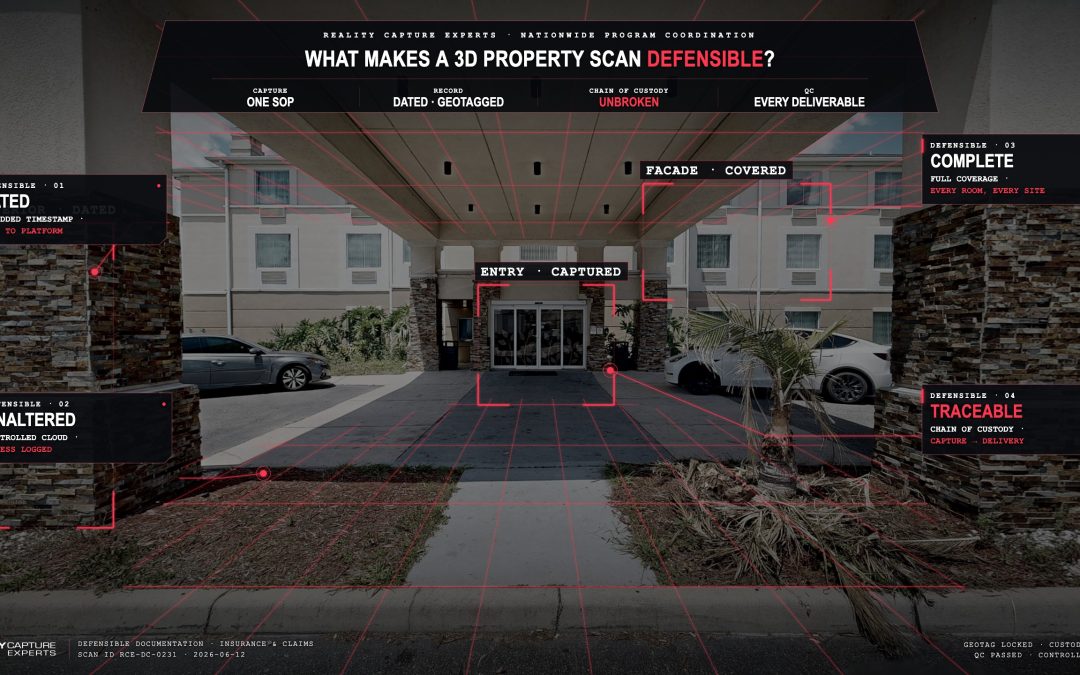
A 3D property scan defensible in an insurance claim shares four qualities: it is dated, unaltered, complete, and traceable. Matterport captures are timestamped and geotagged, which makes them difficult to manipulate after the fact — and that is the quality adjusters, attorneys, and forensic teams look for. A defensible scan is less about the camera and more about the discipline around the capture: clean coverage, a clear date, and an unbroken record of custody.
This is part of a broader practice we cover in our guide to pre-loss property documentation. Here we focus on the one question that decides whether a scan helps or hurts: will it hold up?
What does “defensible” actually mean for a scan?
Defensible means the record can survive scrutiny. If a claim is contested, the other side will ask when the data was captured, whether it could have been altered, who handled it, and whether it actually shows the area in dispute. A scan that answers all four cleanly is an asset. A scan with a fuzzy date, gaps in coverage, or no record of custody invites doubt.
3D scans are often treated as strong evidence precisely because they are timestamped and cannot be easily manipulated. But that strength only holds if the capture and handling are disciplined from the start.
The four qualities that make a 3D property scan defensible
Not every scan holds up under scrutiny. The ones that do share four qualities that make a 3D property scan defensible — and each one can be planned for before capture begins.
Dated. The scan must carry a reliable, embedded date that cannot be modified after the fact. Matterport captures are timestamped at the moment of capture and tied to the platform record, so the date is not a label someone added to a folder — it is built into the file. For pre-loss work, this is the entire point: a baseline dated months before a loss gives an adjuster a fixed reference point for what existed before the event.
Unaltered. The scan must be traceable to its original state. Files stored in controlled cloud platforms with access logs create an auditable record — if the file has not changed since capture, that is verifiable. Files that have passed through unknown hands, been exported to local drives, or moved without documentation introduce doubt about whether the record reflects reality at the time of capture.
Complete. The scan must cover the full space, not a selection of angles. A scan that misses the area in dispute is no better than a folder of photos that missed the same corner. Complete coverage means every room, every area of the site documented to the agreed scope — so the record holds up regardless of which part of the property a claim turns on.
Traceable. The scan must have a documented chain of custody: who captured it, when, with what equipment, and how it was stored and delivered. Traceability is what separates a clean record from one that can be challenged on handling grounds. An unbroken chain — from trained operator to controlled cloud storage to delivery — is often what decides whether evidence holds in subrogation and contested claims.
Why does timestamp and geotag matter so much?
Because the central question in most disputes is “what did this look like, and when?” A Matterport capture embeds the date and location into the file, so the record carries its own proof of when and where it was taken. That removes the weakest link in photo-based documentation — a folder of images with no reliable date and no proof they show the right property.
For pre-loss work, the timestamp is the entire point. A baseline scan dated months before a loss lets an adjuster compare before-and-after and isolate what the event actually changed.
What is chain of custody, and why does it decide defensibility?
Chain of custody is the documented trail of who captured the data, when, and how it was stored and transferred. In insurance and subrogation, an unbroken chain is often what separates evidence that holds from evidence that gets thrown out. Records that are timestamped, stored in tamper-resistant cloud platforms, and traceable to a known operator carry weight; records that passed through unknown hands do not.
This is where a managed capture program has a structural advantage over a do-it-yourself model. When capture is handled by trained operators to a single SOP, with consistent file handling and cloud storage, the chain of custody is built in. When every site captures its own way with whatever device is handy, the chain is only as strong as its weakest location.
What makes a scan fail when it’s challenged?
Three failures show up again and again: an unclear or missing capture date, incomplete coverage that misses the area in dispute, and no record of who captured or handled the file. A fourth is inconsistency across a portfolio — when one site’s scan looks nothing like another’s, the whole body of evidence looks improvised.
The fix is process, not equipment. A defensible record comes from capturing to a standard every time, which is the difference between a scan and a pile of photos.
How does RCE keep scans defensible?
RCE captures to one SOP nationwide: trained operators, consistent coverage at every site, dated and geotagged Matterport files, and QC on every deliverable before it leaves our hands. Files are stored and transferred through controlled cloud platforms, so the custody trail stays intact from capture to delivery. The result is a body of evidence that looks the same at site 1 and site 200 — which is what makes it hold up.
Frequently Asked Questions
Are 3D scans admissible in court?
3D scans are timestamped and difficult to manipulate, which is why they are widely used in claims and forensic work. Admissibility depends on jurisdiction and case specifics, so RCE focuses on capturing clean, dated, well-documented records rather than offering legal assurances.
Does the type of camera affect defensibility?
Less than people expect. Consistent coverage, a reliable date, and an unbroken chain of custody matter more than the specific device. RCE standardizes the capture so those fundamentals are met every time.
How is chain of custody maintained for a scan?
Through trained operators, controlled cloud storage, and consistent file handling from capture to delivery. RCE’s managed workflow keeps that trail intact rather than relying on each site to manage it alone.
What if a site was captured before we had a formal program in place?
Older captures without a documented chain of custody are harder to defend. Going forward, a managed program establishes the standard at every site so the record holds from the first capture.
What Happens Next
If defensibility matters for your portfolio, the starting point is a standard: how each site is captured, how files are dated and stored, and who handles them. RCE sets that standard once and applies it to every location, so the record is ready before anyone asks whether it will hold up.