
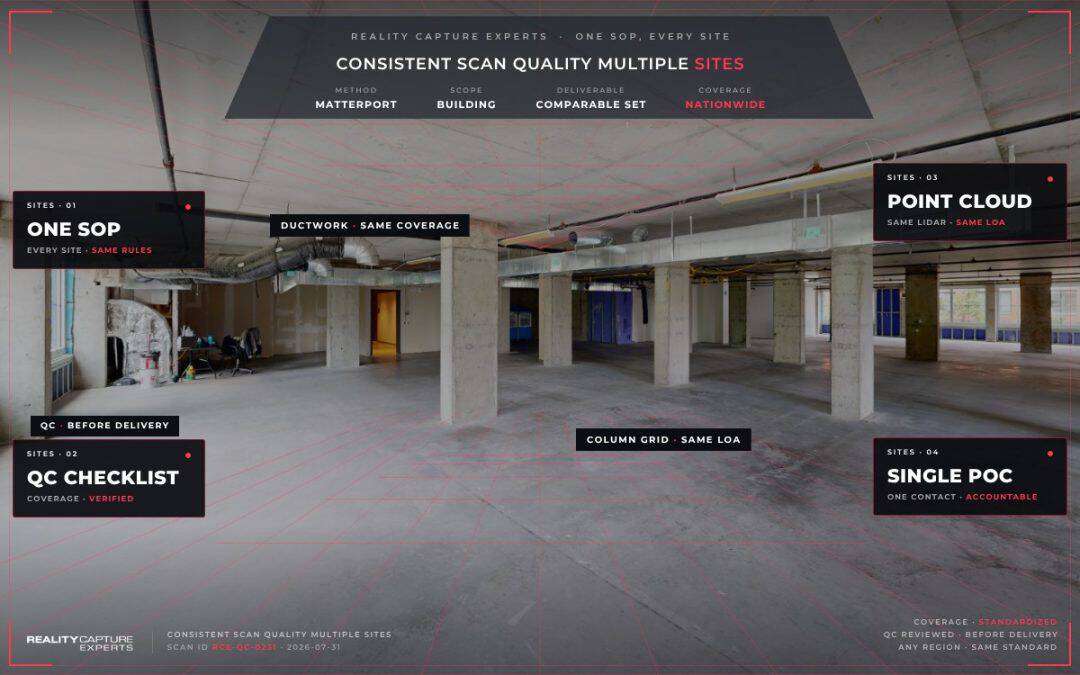
You keep scan quality consistent across multiple sites by running every location against the same SOP, the same LiDAR settings, and the same QC checklist, managed by one point of contact instead of each site sourcing its own vendor. Consistency comes from process, not from any single technician or camera.
Key Takeaways:
- Consistent scan quality comes from one SOP, one QC checklist, and one point of contact, not from any single technician or camera.
- Independent, site-by-site vendor sourcing is the most common cause of quality drift across a portfolio.
- QC review happens before delivery, catching coverage gaps instead of leaving clients to find them later.
- One point of contact means one accountable answer for quality questions, instead of a vendor-by-vendor guessing game.
Why Does Quality Drift When Sites Book Capture Independently?
When each site or region hires its own capture vendor, quality drift is close to guaranteed. One vendor scans every room; another skips storage and mechanical areas to save time. One uses current-generation LiDAR hardware; another uses an older camera or a phone-based tool. None of that shows up until someone tries to compare two sites side by side and realizes the data is not equivalent.
What Does a Standardized Capture SOP Actually Control?
A capture SOP controls the things that make data comparable: which rooms and zones get scanned at every site, what level of accuracy the LiDAR capture targets, how the walkthrough sequence is structured, and what the QC checklist confirms before a file is marked complete. RCE applies the same SOP nationwide regardless of which field team is on site that week, so a scan from a facility in Georgia and one in Oregon follow identical coverage rules. Similar standardization approaches are outlined in Matterport’s guide to optimizing Matterport scanning across multi-site locations.
How Does QC Catch Problems Before Delivery?
QC review happens before a scan is delivered, not after a client notices something is missing. A reviewer checks coverage against the SOP, confirms measurements and floor plan accuracy, and flags any inaccessible area so it is documented rather than silently absent. That review step is what keeps one rushed technician from becoming an inconsistent site in the portfolio record.
How Does One Point of Contact Make This Easier at Scale?
A single point of contact means the facilities team is not managing scheduling, quality questions, and file delivery across a dozen regional vendors. One team coordinates scheduling nationwide, one QC standard applies everywhere, and one contact is accountable if a site’s data does not meet the bar, instead of a diffuse set of local vendors each managing their own small piece of the portfolio. Matterport describes a comparable model in standardizing multi-site operations for portfolio operators.
This consistency is one piece of the larger record every site in a portfolio needs. See RCE’s pillar guide on facility compliance and capital planning across multiple sites for how it fits into the full picture.
What Happens Next / How RCE Handles This
RCE assigns coordinated field teams against a shared national schedule, applies the same SOP and QC checklist at every site regardless of location, and routes every deliverable through one point of contact so quality questions have a single, accountable answer instead of a vendor-by-vendor guessing game.
FAQ
How do you handle sites in different regions with different field teams?
Every field team works from the same SOP and QC checklist, so the site’s region does not change what gets captured or how it is reviewed.
What happens if a site’s scan does not meet the QC standard?
It is flagged and addressed before delivery, either through a follow-up capture or a documented note on the specific gap.
Can we set a stricter LOA for some sites and a lighter one for others?
Yes. Level of accuracy is scoped per site or per site type at the start of the program, then applied consistently within that scope.
Who do we call if we have a quality question about one specific site?
One point of contact handles quality questions across the whole program, not a different contact per region.