
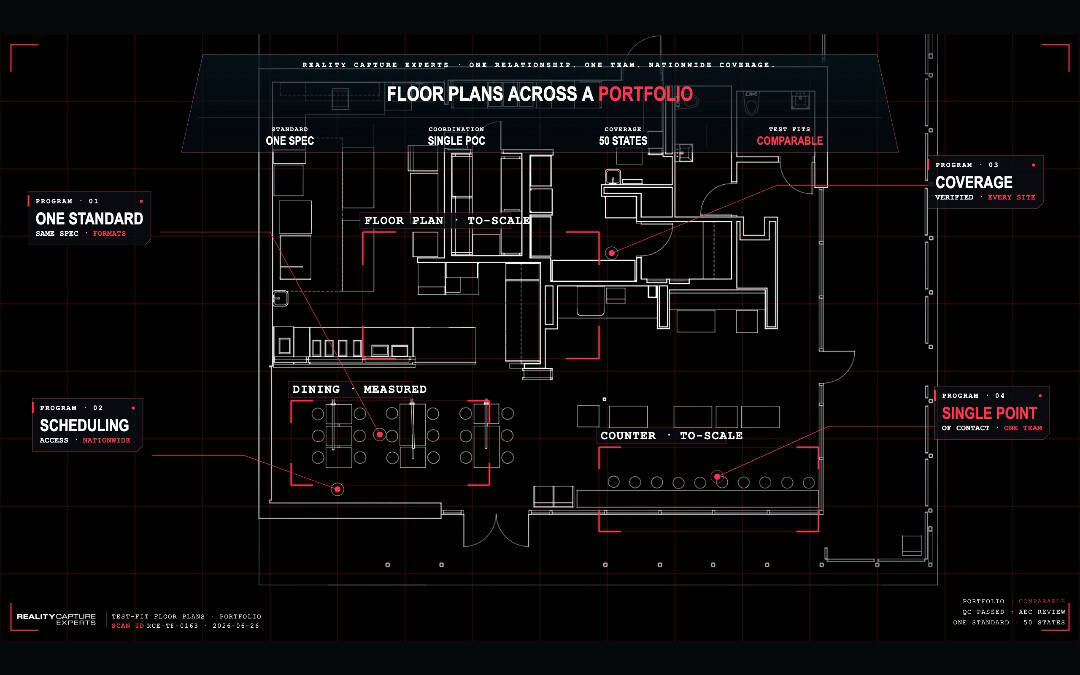
You get accurate floor plans for test fits across a portfolio of locations by treating capture as one coordinated program instead of a series of separate vendor hires. The goal is the same standard of measured, current floor plan in every location — so test fits across markets are comparable and dependable. The obstacle is rarely the technology. It is the coordination: scheduling, access, quality control, and consistent delivery across many sites at once.
This post covers why the do-it-yourself approach breaks down at scale and what a managed program does instead.
Why are accurate floor plans for test fits hard at portfolio scale?
Because the problem multiplies with every location. Getting one accurate floor plan is a task. Getting the same accurate floor plan in fifteen markets, to one spec, on a timeline, is a program. Property teams routinely struggle with inaccurate and outdated commercial real estate floor plans stored in places that make sharing hard — and the larger the portfolio, the more time gets lost just tracking down the most current version of each plan.
When teams solve this site by site, the cracks show fast. A capture vendor in one market delivers a clean, measured floor plan a planner can use. A vendor in another market delivers something rougher, in a different format, at a different level of detail. Now the two test fits built on that data are not comparable, and the asset manager comparing options is comparing apples to a guess. Multiply that across a national portfolio and the inconsistency becomes the dominant problem.
What goes wrong with the do-it-yourself, vendor-by-vendor model?
The self-serve model pushes all the coordination onto your team. You find a capture provider in each market, brief each one separately, hope each delivers to the same standard, chase the ones that slip, and reconcile the formats afterward. Every market is a new vetting exercise and a new point of failure. There is no single standard because there is no single owner.
The failure is not that any one vendor is bad. It is that nobody is accountable for consistency across all of them. Quality drifts location to location. Turnaround is unpredictable because each vendor has its own queue. And when a test fit comes back questionable, it is hard to tell whether the problem is the planner or the data — because the data itself was produced differently in every market.
This is the contrast that matters: the alternative leaves you managing scanning, operators, and vendors site by site. That is a coordination burden that does not scale, and it is exactly the problem the test fit pillar is built on.
What does a managed, coordinated program do instead?
A managed program puts one team in charge of the whole thing. Scheduling, access coordination, capture, quality control, and delivery run through a single point of contact, to one standard, in every location. The floor plans come back consistent because they were produced consistently — same process, same QC, same format, regardless of geography.
That consistency is what makes portfolio test fits trustworthy. When every location’s existing-conditions data was captured and checked the same way, a planner can build comparable test fits across the portfolio, and an asset manager can compare options knowing the baselines match. Centralized capture also solves the version problem: the deliverables land in one place, to one naming standard, instead of scattered across separate inboxes.
Matterport is the capture technology underneath. The managed program is what turns it into consistent, usable documentation at scale — measured floor plans, point clouds, or BIM, produced to the spec each project needs. For the deliverable detail planners care about, see what a space planner needs from a scan. The market backdrop for this efficiency focus is laid out in the CBRE U.S. Real Estate Market Outlook 2026.
How RCE handles this
RCE runs portfolio capture as one program. We confirm the locations, access windows, and intended use up front, then coordinate Matterport capture across every market — managing technician scheduling and site access so your team does not have to. Every space is verified for full coverage. A dedicated AEC specialist reviews each deliverable against scope, and documentation is delivered to one standard across all 50 states, through a single point of contact. Post-production notes travel with each location so nothing is a surprise later.
The outcome is a portfolio of floor plans a space planner can build on with confidence — consistent location to location, comparable test fit to test fit. One relationship covers every market.
Frequently asked questions
Why not just hire a capture vendor in each market?
Because no one is accountable for consistency across them. Quality and format drift location to location, which makes test fits across the portfolio non-comparable and hard to trust.
How does a managed program keep floor plans consistent?
One team owns scheduling, capture, quality control, and delivery to a single standard in every location, so the deliverables come back the same regardless of geography.
Can RCE coordinate capture in every market we operate in?
RCE coordinates field operations across all 50 states through a single point of contact, with documentation delivered to one standard nationwide.
What deliverables can we get for portfolio test fits?
Measured floor plans, point clouds, and CAD or BIM, produced to the spec each project needs — consistent across every location in the program.