
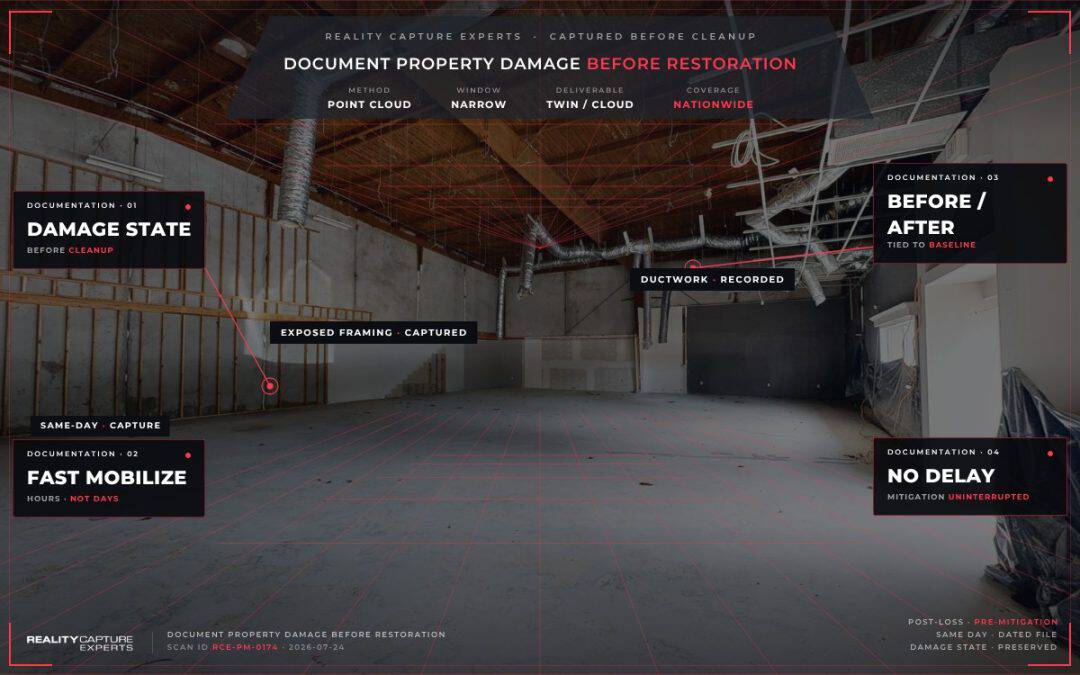
Document property damage before restoration begins by capturing a complete spatial record of the site in its post-loss state, before any cleanup, demolition, or repair work starts. Once mitigation begins, that damage state is gone permanently, so the capture window is narrow and needs to happen fast.
Why does timing matter so much here?
Restoration crews often need to start mitigation quickly to prevent further damage, especially with water or fire events. That creates a real tension: document everything first, or stop further loss first. A fast, coordinated capture that happens the same day damage is discovered – before crews start moving debris or drying equipment – resolves that tension without delaying mitigation.
What should be captured in a post-loss, pre-mitigation scan?
Full coverage of every affected area, close documentation of the specific damage type (water lines, char patterns, structural cracking), and clear reference points connecting the post-loss scan back to the pre-loss baseline, if one exists. Without a pre-loss baseline, the post-loss scan has less to compare against, which is part of why proactive documentation matters before an event, not just after.
Does documentation change if the damage involves multiple buildings on one site?
Yes. Multi-building sites need the same treatment applied consistently across every affected structure, not just the most visibly damaged one. A capture plan that covers only the obvious damage risks missing secondary issues in adjacent buildings, which can surface later in the claim process if they were not documented at the same time.
Who typically coordinates this kind of urgent capture?
On a single site, it’s usually whoever manages the property or the incident response. Across a multi-site portfolio, urgent capture needs a coordination point that can mobilize a field crew fast without the property team having to source a vendor from scratch during a crisis. That’s the operational role RCE plays: a standing capture relationship means a crew can be dispatched quickly instead of a property manager cold-calling scanning vendors mid-emergency.
Does this delay the restoration timeline?
A well-coordinated capture adds hours, not days, to the front end of a restoration timeline. Because it happens before mitigation, it doesn’t interfere with drying, demolition, or repair schedules once those begin – it just needs to happen first. Crews on-site can typically begin setup and non-destructive prep work in unaffected areas while the capture team documents the damaged zones.
What if a claim is still open when the capture happens?
An open claim is exactly when a documented post-loss scan matters most. It gives the adjuster and the client a shared, dated reference for the damage extent before any repair work changes the site, which reduces disputes later about what was actually affected.
What happens next / How RCE handles this
RCE maintains standing capture relationships with portfolio clients so a post-loss scan can be scheduled fast when an event happens, without a cold start. Field crews follow a consistent damage-documentation SOP, and delivered files reference back to any existing pre-loss baseline for that site, giving the claim team a clear before-and-after record.
This is the third post in this week’s series on documentation that holds up. For the proactive counterpart to this post, see what a pre-loss property documentation program includes for multi-site portfolios.
FAQ
How fast can RCE mobilize for post-loss documentation? Mobilization timelines depend on region and existing client relationship; portfolios with a standing RCE capture agreement get faster response than a first-time, cold-start request.
Does this work if there’s no pre-loss baseline for the site? Yes, though the comparison is stronger with one. A post-loss-only scan still documents the damage state clearly on its own.
Can restoration crews start work while capture is happening? Capture should be completed first in affected areas to preserve the damage state; RCE coordinates timing with the restoration team to avoid delay.
Is this the same service as a pre-loss survey? No – it’s the reactive counterpart. See the companion post on pre-loss surveys for the proactive side of this.