
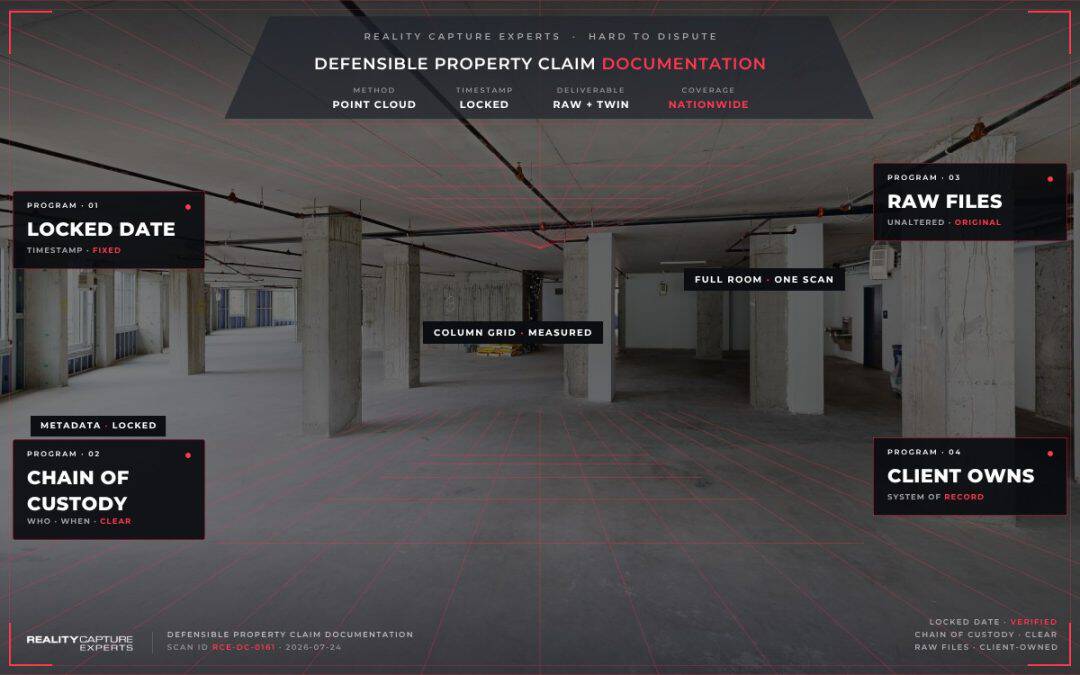
Defensible property claim documentation is a record that can’t be credibly disputed on origin, timing, or authenticity – meaning the capture date is locked, the chain of custody is clear, and the files haven’t been altered after the fact. For a claim, that’s the difference between documentation an adjuster accepts and documentation that becomes its own argument.
What makes documentation defensible versus just “nice to have”?
Three things: a timestamp that can’t be edited after capture, a clear record of who captured it and how, and a file format that preserves the original data rather than a compressed or cropped version. GPS tagging and consistent metadata matter because forensic reviewers compare timestamps, location data, and file properties to check whether a record’s story holds together.
How do timestamps and GPS tags actually get used in a dispute?
When a claim is contested, forensic consultants and adjusters look for internal consistency – does the metadata match the claimed sequence of events? A point cloud capture with a locked timestamp and location tag gives a clear, hard-to-dispute answer to “when was this documented and where.” Photos with editable metadata or unclear provenance carry much less weight.
Does the capture method affect defensibility?
Yes. A single point cloud capture that covers a full room in one continuous scan is harder to argue with than a series of individual photos, because it can’t be selectively cropped or staged the way a photo series can. The completeness of the capture is itself part of what makes it defensible. A gap in coverage, whether from a skipped room or a missed angle, is exactly the kind of hole a dispute can widen.
Who should hold custody of the documentation files?
The client, ideally in a system of record the client controls, with a clear record of who captured the data and when it was delivered. RCE delivers files directly to the client’s system rather than holding them in a proprietary platform, so there’s no ambiguity about custody when a claim is being reviewed. That clarity matters just as much for portfolios working with multiple insurers or brokers over time, where a single vendor-locked platform would otherwise complicate access.
How does defensible property claim documentation hold up under forensic review?
Defensible property claim documentation holds up because it gives a forensic reviewer something to check against, not just something to take on faith. Locked timestamps, unedited files, and a documented chain of custody let a reviewer verify consistency rather than rely on assurances, which is exactly the kind of scrutiny a disputed claim invites.
What happens next / How RCE handles this
RCE’s capture SOP locks capture date and location data into the file record at the point of scanning, before delivery, so nothing about timing or origin is left ambiguous later. Every site is captured and QC’d to the same standard and delivered with clear documentation of who captured it and when, giving a risk team a record they can hand to an adjuster or forensic reviewer without hesitation.
This is the second post in this week’s series on documentation that holds up. For the broader baseline this builds on, see what a pre-loss property documentation program includes for multi-site portfolios.
FAQ
Can documentation be challenged even if it’s a 3D scan? Any documentation can be questioned, but a locked-timestamp point cloud with clear custody is far harder to dispute than photos or memory-based descriptions.
Does RCE provide documentation of the chain of custody? RCE documents who captured each site and when, as part of the standard delivery record.
What if a claim reviewer wants raw, unedited files? RCE delivers the underlying point cloud and imagery, not just a processed summary, so the original capture data is available if requested.
Is this different from what a public adjuster provides? It’s complementary – a public adjuster interprets and argues the claim; the point cloud provides the underlying spatial evidence they’re arguing from.