
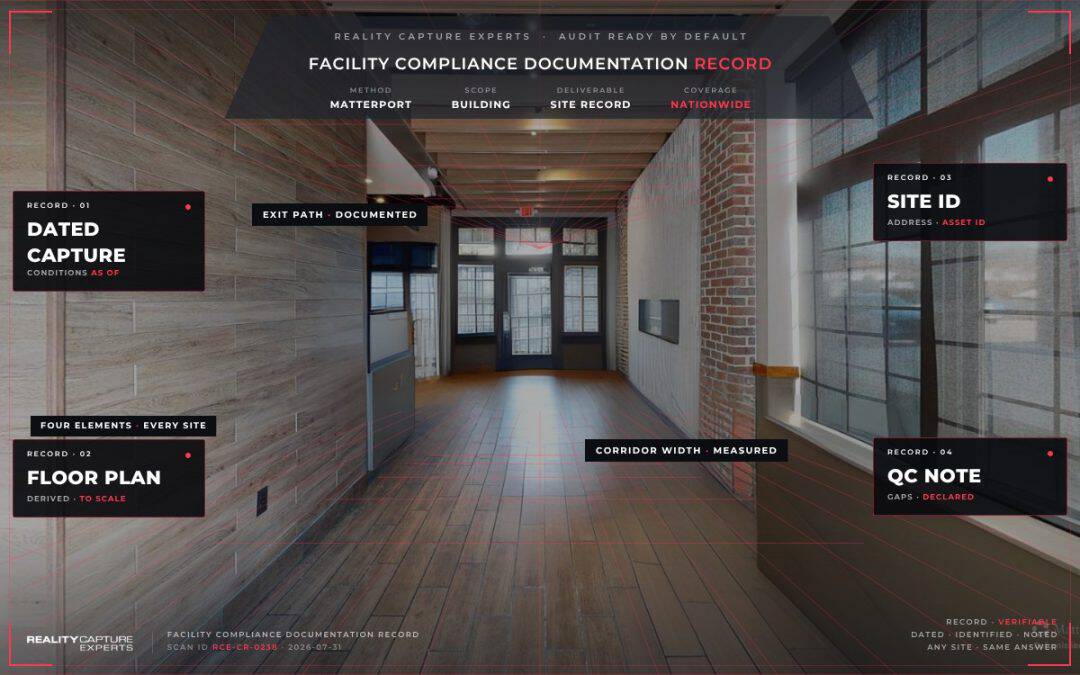
A facility compliance documentation record needs a dated 3D capture of the site, a derived floor plan, the site address and asset ID, and a QC note confirming what was and was not covered during that visit. Together, those four pieces are what let an auditor or insurer trust the record instead of questioning it.
Key Takeaways:
- A complete compliance record needs four things: dated capture, floor plan, site address/asset ID, and a QC coverage note.
- The capture date turns a record into verifiable evidence instead of an unverifiable claim.
- A QC note documenting what was and wasn’t covered is what keeps a small gap from becoming an audit finding.
- At portfolio scale, the same four elements in the same format for every site is what makes records comparable and auditable.
Why Do Auditors Push Back on Incomplete Records?
An auditor’s job is to find the gap. A record with no capture date, no confirmation of what areas were included, or no consistent format across sites gives them exactly that gap to point to. The problem is rarely that nothing was documented. It is that what was documented cannot be verified or compared against another site’s record.
What Role Does the Capture Date Play?
The capture date is what turns a record into evidence instead of an assumption. “Conditions as of March 2026” is a claim someone can check. “Conditions, undated” is not. Every RCE deliverable is tied to its capture date by default, so the record answers not just what a space looked like, but when.
Why Does the QC Note Matter as Much as the Scan Itself?
The scan shows what was captured. The QC note shows what was intended to be captured and confirms whether that happened. If a mechanical room was locked during the visit, the QC note says so, rather than leaving a silent gap an auditor discovers on their own. That single detail is often the difference between a record that holds up and one that raises more questions than it answers. The same principle applies to 3D scanning for insurance and loss adjustment, where a dated, verifiable record is what makes a claim defensible.
How Does This Look Different at Portfolio Scale?
At the scale of one building, a compliance record is a file. Across 50 or 100 sites, it is a system: the same four elements, in the same format, for every site, so a compliance officer can pull any location and get the same kind of answer. That consistency is the entire value of a managed capture program over a patchwork of independent site vendors, and it is the same consolidation trend covered in 2026 facilities management trends.
This record is one part of the larger program described in RCE’s pillar guide on facility compliance and capital planning across multiple sites.
What Happens Next / How RCE Handles This
RCE builds each site’s record with the same four elements every time: dated capture, floor plan, site identifiers, and a QC coverage note, delivered through one point of contact so the compliance team can request any site’s record and get a consistent answer without chasing down a regional vendor first.
FAQ
Does the compliance record need to include floor plans, or just the 3D scan?
Both. The floor plan is what most compliance and facilities teams reference day to day; the 3D twin is the underlying record it was derived from.
What if a past site record is missing a capture date?
It is a known gap. Rescanning going forward with dated captures is the fastest way to close it for future audits.
Can this documentation format satisfy insurance as well as compliance requirements?
The same underlying record can support both use cases, though specific insurance documentation needs should be confirmed with your carrier.
How do we request a specific site’s record once it’s part of the program?
Through the single point of contact managing the portfolio, regardless of which field team originally captured that site.