
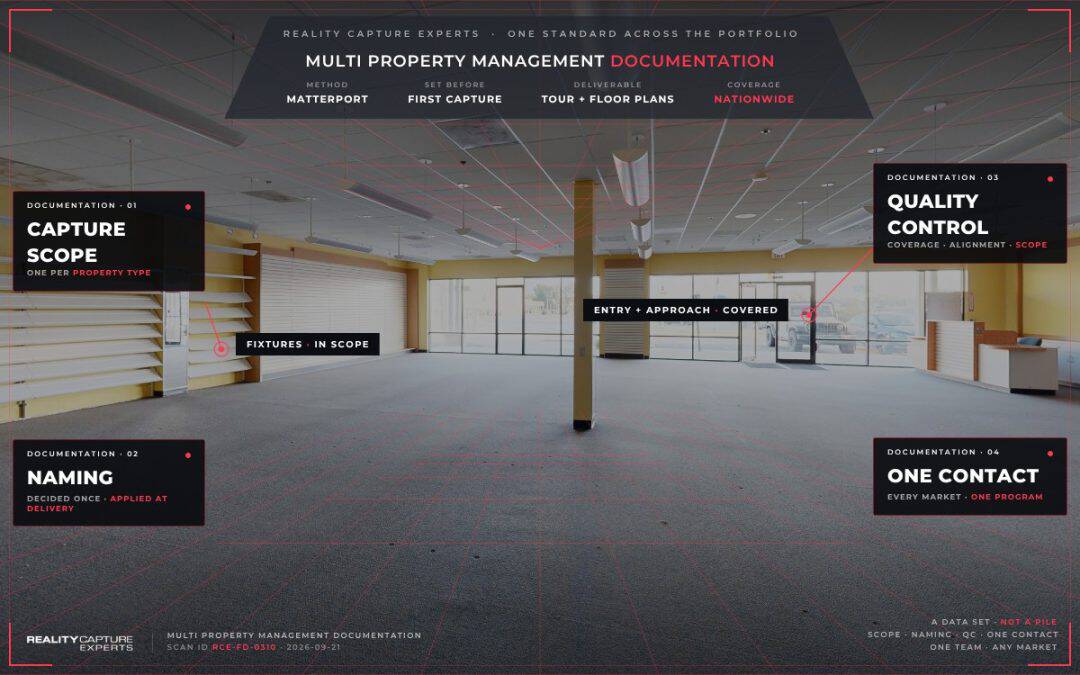
Multi-property management documentation is a single capture and filing standard applied to every property an investor owns, so records stay comparable across the portfolio. It requires four decisions made before capture: one capture scope per property type, one naming convention, one quality control standard, and one coordinating contact.
Why does portfolio documentation fall apart as you scale?
It rarely fails on one property. It fails in aggregate, and quietly.
The usual path is opportunistic. A property gets captured because a lender asked. Another gets captured because a renovation needed it. A third gets a walkthrough video from the property manager’s phone. Each decision was reasonable. The result is a portfolio where no two records are comparable, filed under three conventions, at three levels of detail.
As portfolios expand, manual and ad hoc systems stop scaling. Scattered files, inconsistent naming, and records spread across email create exactly the friction that makes an investor stop trusting their own documentation.
The tell is simple. If you cannot answer a condition question across the whole portfolio without opening properties one at a time, the documentation is not a data set. It is a pile.
What has to be standardized before capture starts?
- A capture scope per property type. Not one scope for everything. A single family rental, a small multifamily building, and a hospitality property each need a defined walk, so any two properties of the same type are comparable to each other.
- A naming and folder convention. Decided once and applied at delivery, tied to the identifier you already use. Portfolio filing practice converges on property first, then category, with dates inside filenames rather than in folder names.
- A quality control standard. A defined check every capture passes before acceptance, covering coverage gaps, alignment, and whether the agreed scope was actually followed.
- One coordinating contact. A single party sequencing capture across every market, rather than an operator per market each running their own process.
These cost a conversation to decide up front and a re-capture program to retrofit. Renaming two hundred deliverables after the fact is a project nobody budgets for.
How do you keep quality consistent across markets?
Consistency across geography is a management problem, not an equipment problem. The hardware is the same in every market. The variable is who is holding it and whether they are working to the same written scope.
A managed program keeps the scope and the quality control central regardless of which technician covers a given market. Every capture is reviewed against the same standard by the same team before it is accepted, and a capture that misses part of the scope is corrected before delivery rather than discovered a year later by a lender.
The contrast is sourcing an operator market by market. Each may be entirely competent, and each brings different habits, and nobody is comparing output across markets. Variation accumulates until the portfolio is no longer a set.
What does a standardized portfolio record let you do?
The payoff is what becomes possible afterward:
- Compare properties. A condition question gets answered across the portfolio rather than one building at a time.
- Get comparable quotes. Renovation pricing from the same record shape means the variance is in the work, not the information.
- Refinance and report faster. Lender and investor requests get met from an existing record rather than a scramble.
- Onboard managers cleanly. A new property manager reviews the property before their first day.
- Support disposition. A buyer gets a complete as-built package, which shortens their diligence and your close.
Portfolio reporting discipline follows the same logic used for financials, where every property reports on one cadence, one definition set, and one format so that a portfolio review reflects reality. Documentation deserves the same treatment.
What does the capture scope actually specify?
A scope that stops at “capture the property” produces exactly the inconsistency it was meant to prevent. A scope that holds up names the spaces a technician must record even when they are unremarkable:
- Every habitable room, including closets and secondary spaces
- Mechanical, electrical, and plumbing equipment with nameplate detail where readable
- Attics, crawl spaces, and basements where safely accessible
- Roof condition where it can be captured safely from an accessible point
- Exterior elevations on all sides, plus parking, drainage, and approach
- Any known problem area flagged in advance by the manager or inspector
The spaces that get skipped without a written scope are always the same ones: utility rooms, crawl spaces, and the back elevation. They are also the ones that generate questions later.
How should a portfolio program be sequenced?
Few investors capture everything at once, and attempting it usually stalls the program. Sequencing that holds up:
- Highest value or highest exposure properties first
- Anything facing a refinance, disposition, or insurance renewal inside twelve months
- Properties about to enter renovation, captured before demolition
- Properties changing property manager
- Everything else, grouped by market to compress travel
Fix the scope and naming convention in phase one even if phase one is four properties. That is what lets phase four join the same data set instead of starting a second one.
What happens next
RCE runs portfolio documentation as a centralized program. Scoping starts from the property list and the property types in it. Capture scopes are written per type and confirmed before any technician is dispatched. Access and scheduling are coordinated centrally across markets, every capture passes the same quality control review, and deliverables arrive under one naming convention tied to your own property identifiers.
A property list and the date driving the timeline are enough to start. For the program view, see virtual tours for investment properties, and for building the process around it, the documentation workflow.
Frequently asked questions
How many properties make a managed program worth it?
The shift usually arrives where coordination cost exceeds capture cost, which for most investors is well under twenty properties. Portfolios in the low dozens already face the consistency problem.
What if properties are held across different LLCs?
Common, and it does not change the capture standard. The filing convention should sit above entity boundaries so the portfolio is reviewable as a whole, with entity mapping handled in the naming rather than by splitting the archive.
Can we standardize records we already have?
Partly. Existing captures can be renamed and refiled to the convention. What cannot be retrofitted is coverage, so properties captured to a thinner scope stay thinner until they are recaptured.
Who holds the files?
You do. RCE delivers into your environment under the agreed structure so the records stay usable by your lenders, managers, and design teams without a translation step.