
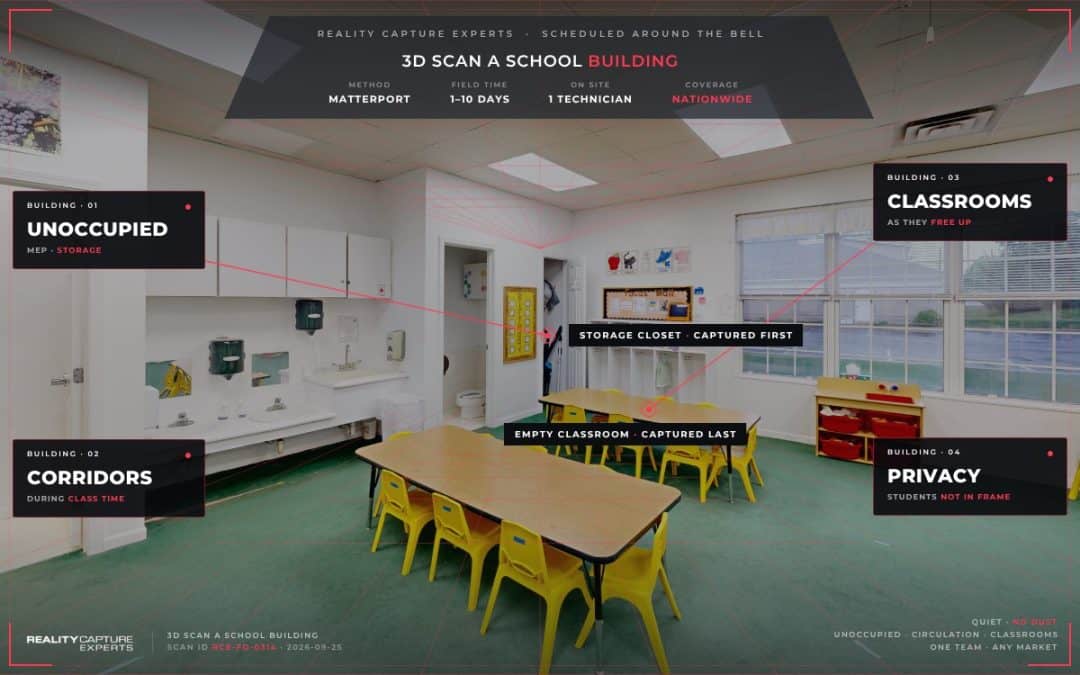
RCE does not scan a school building while school is in session. Capture happens during breaks, after hours, or on weekends, when the building is empty of students and a technician can work through every room without interruption. That keeps the school day intact and the scan clean.
Key Takeaways
- RCE does not scan a school building while school is in session. Capture happens during breaks, after hours, or on weekends.
- An empty building produces a cleaner scan, with no people in the model and no disruption to instruction.
- A school contact who can unlock rooms has the biggest effect on how fast a capture day goes, and anything left closed is not captured.
- Scan time is predictable at about one day for an elementary school, but access sets the calendar.
When does capture happen?
School capture is built around the academic calendar. Winter break, spring break, and summer give a technician the longest uninterrupted windows, and evenings and weekends during the school year suit buildings that cannot wait for a break. Practitioners who scan schools regularly describe the same pattern, with captures on weekends and holidays so that nobody walks through the finished tour. The 67 tips for creating Matterport digital twins of schools list it among the first things to expect.
An empty building also produces a better scan. A Matterport camera records everything it can see from each position, so a student at a desk, a teacher in a doorway, or a crowd in a corridor becomes part of the model. Scheduling capture when no one is present avoids that problem at the source, and it means the work never touches instruction. Exterior views through windows come out best in daylight, so where the record needs them, weekend and break hours during the day are worth planning for.
How do you prepare a school for capture?
Preparation is mostly about doors and people. A technician can only document what is open, so a school contact needs to unlock classrooms, offices, storage rooms, and mechanical spaces ahead of the camera, and anything left closed is not captured. Written instructions sent to the school before the day, covering which rooms matter and how they should be left, prevent most surprises. Practitioners also recommend keeping doorstops on hand so rooms stay open while the camera works, and having the school contact stage each space just ahead of the technician as the capture moves through the building.
Schools have their own quirks. Glass trophy cases, polished gym floors, and glossy hallway walls reflect, so the technician has to position the camera and stand carefully to stay out of the model. Large campuses can also run a full day without a real break, which is one reason a capture day is planned as a working shift rather than a quick visit.
What about student privacy?
Capturing an empty building removes most of the privacy question, but classrooms still carry student work and photographs on the walls. Matterport includes a blur tool that lets the school obscure those images in the finished model, and some districts also turn off the dollhouse view because blurring does not carry into it. Password protection while the model is in review keeps it confidential until the district approves it. These are district decisions, and they are far easier to make before the capture than after it.
How long does it take to scan one school?
For a typical elementary building, one day. For a middle school, one to two days. For a large high school in the range of 200,000 to 500,000 square feet, three to ten days depending on complexity and how much of the building is available at once.
Those numbers describe scan hours. The calendar can run longer, because access constraints add days even when capture time stays flat. Unlocking rooms, badging, and phased entry are the usual reasons a two day scan takes four calendar days. That distinction is worth holding onto when you build a district schedule, because field time is predictable and access is what you have to manage.
What does the finished scan get used for?
The same capture serves several jobs. In Aberdeen, South Dakota, Digital Twin Imaging captured every kindergarten through 12th grade room and annotated the models with defibrillators, fire extinguishers, exits, and hydrants. In timed SWAT training simulations, officers using the Matterport models cut room to room search times from over seven minutes to under thirty seconds, according to Matterport’s public safety case study. The same case study reports that Okoboji Middle School used its digital twins to plan remodeling with fewer repeat site visits, with estimated savings of $50,000 across project phases.
For a district, that means one set of scans can feed condition assessments, space planning, and safety floor plans. The planning side is covered in what school safety floor plans have to include and what goes into a facility condition assessment for schools.
What Happens Next
RCE starts with your building list, break calendar, and access contacts, then sequences capture building by building against them. Technicians are deployed with a written scope, every scan goes through specialist quality control with post production notes, and one point of contact handles scheduling, coordination, and delivery so principals and custodial staff are not fielding logistics calls.
Reach the team at 833-723-8326 or info@realitycaptureexperts.com.
Related reading: how to document facility conditions across an entire school district and measuring classroom space utilization across a campus.
Frequently Asked Questions
Do you scan while school is in session?
No. RCE scans during breaks, after hours, or on weekends.
Does the scan capture students or their work?
A building scanned while it is empty of students does not contain them. Classroom walls often carry student work and photographs, and Matterport includes a blur tool that lets the school obscure those images in the finished model. Which spaces to blur, and who can view the model, are district decisions that are easier to settle before the capture than after it.
Is the equipment loud or disruptive?
No. The camera sits on a tripod and is stationary while it captures. There is no noise beyond a quiet rotation, no dust, and no cabling run across floors.
Does someone from the school need to be on site?
A school contact who can open doors and mechanical rooms makes the day go faster, and rooms that stay locked are not captured. Sending written instructions ahead of the day, covering which rooms matter and how they should be left, prevents most surprises.
How long does it take to scan one school?
For a typical elementary building, one day. For a middle school, one to two days. For a large high school in the range of 200,000 to 500,000 square feet, three to ten days depending on complexity and how much of the building is available at once.