
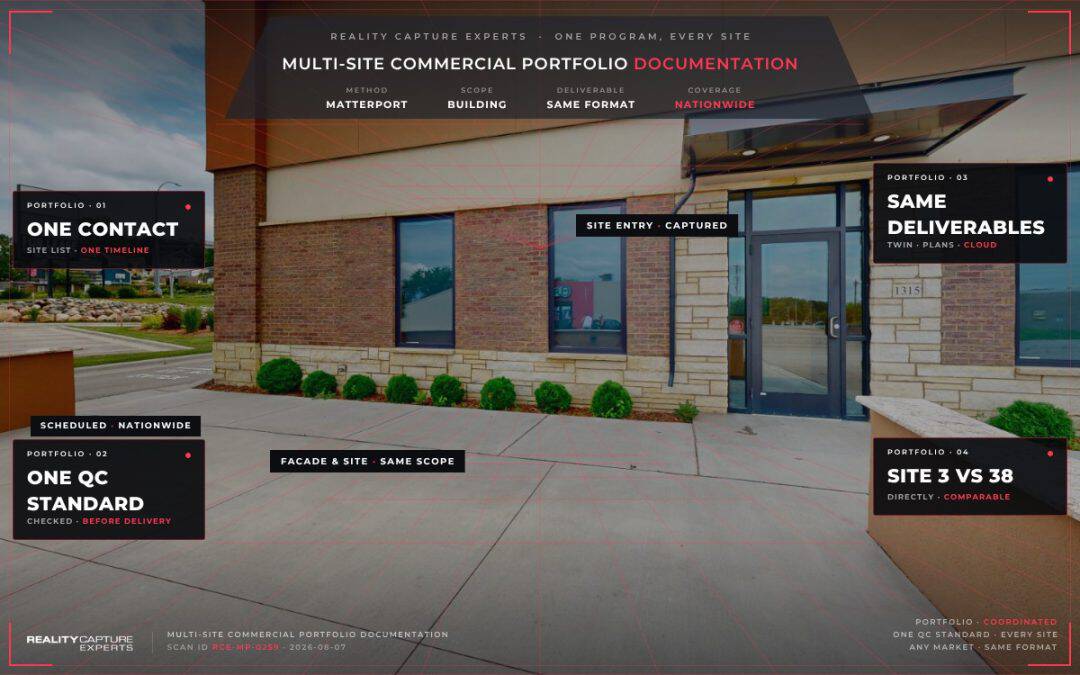
Capture a multi-site commercial portfolio by running 3D capture as one coordinated program instead of a separate vendor decision at every property. That keeps equipment, QC, and file formats the same across every site, no matter how many markets the portfolio spans, and it ties directly into the broader due diligence documentation process for the deal.
Why does site-by-site vendor selection fail on portfolios?
Hiring a different local vendor for each property in a portfolio means a different camera, a different file format, and a different QC standard at every stop. On a single property, that’s manageable. Across 40 or 200 sites, it turns into an inconsistent, hard-to-audit record that makes it difficult to capture a multi-site commercial portfolio with any confidence in the data.
The self-serve model many teams default to – each site or regional manager sourcing their own capture – shifts the coordination burden onto the buyer’s internal team, exactly when that team needs to be reviewing documentation, not chasing vendors. Allegro’s guidance on managing a multi-location CRE portfolio points to the same coordination gap.
Every time a portfolio adds a new market, the site-by-site model adds another vendor relationship, another invoice, and another set of file formats for the buyer’s team to reconcile before anyone can compare properties side by side. Multiply that across a 40- or 100-site acquisition and the coordination overhead alone can rival the cost of the capture work itself.
What does a coordinated capture program look like when you capture a multi-site commercial portfolio?
RCE manages field scheduling, equipment, and QC review centrally, through one point of contact. The buyer’s team submits a site list and timeline once; RCE handles booking crews, tracking progress, and confirming quality across every property in the portfolio, regardless of how many states or markets the site list spans.
Every site comes back with the same deliverables in the same format – Matterport digital twin, floor plans, and point cloud – so a reviewer comparing site 3 to site 38 is comparing apples to apples, not two different vendors’ work. Matterport’s overview of 3D documentation for corporate real estate outlines the same standardization principle.
How do you keep QC consistent across dozens of sites?
Consistency comes from a single QC standard applied by one managing team, not from hoping each local vendor happens to hold the same bar. RCE reviews every capture against the same checklist before it’s marked complete and delivered.
That review catches gaps – a missed room, an incomplete sweep, a floor plan that doesn’t match the walk-through – before the file reaches the buyer’s team, instead of after it’s already been relied on in a report. Catching those gaps before delivery is far cheaper than discovering them mid-underwriting, when a second site visit means losing days off an already tight due diligence clock.
On a large portfolio, that single QC checklist is what lets a buyer’s team trust a status update instead of re-verifying every site’s capture themselves before it gets used in underwriting or space planning. A consistent QC bar is also what makes it possible to capture a multi-site commercial portfolio on a compressed due diligence timeline without sacrificing accuracy at any individual site.
What deliverables should come back from every site?
At minimum, a Matterport digital twin, dimensionally accurate floor plans, and the raw point cloud. Where the portfolio requires it, Scan-to-BIM or CAD output at a specified LOD, delivered in the same file structure for every property. These same deliverables also support the property condition assessment consultant and any surveyor working the same site, so capture only needs to happen once per property.
Keeping deliverables in the same file structure matters as much as the capture itself – a portfolio manager reviewing 40 properties should be able to open any site’s folder and know exactly where to find the floor plan, the point cloud, and the digital twin link. Each Matterport digital twin also supports early-stage screening on its own; see how virtual tours support CRE due diligence for how reviewers use that same deliverable before ever scheduling a site visit.
Frequently Asked Questions
How many sites can be captured at once?
Field scheduling scales to the portfolio – RCE coordinates crews nationwide rather than limiting capture to one region at a time.
Does every site need the same level of documentation?
No. Scope is set per site based on what the deal requires – some properties may need full Scan-to-BIM, others a Matterport digital twin and floor plan.
Who manages scheduling across multiple markets?
RCE manages scheduling centrally through one point of contact, so the buyer’s team is not coordinating individual vendors market by market.
What happens if a site’s documentation doesn’t pass QC?
It’s flagged and recaptured before delivery, so the buyer’s team receives a complete, consistent set rather than finding the gap later.
What Happens Next
Once a buyer or asset manager has a site list, RCE scopes capture requirements, confirms LOD/LOA and any BIM/CAD needs, and schedules field operations nationwide against the portfolio timeline. Deliverables come back through one point of contact, reviewed to one QC standard, so nothing depends on which local vendor happened to be available near a given site. That single point of contact is also who the buyer’s team calls with a status question, instead of tracking down whichever vendor covered a specific property.