
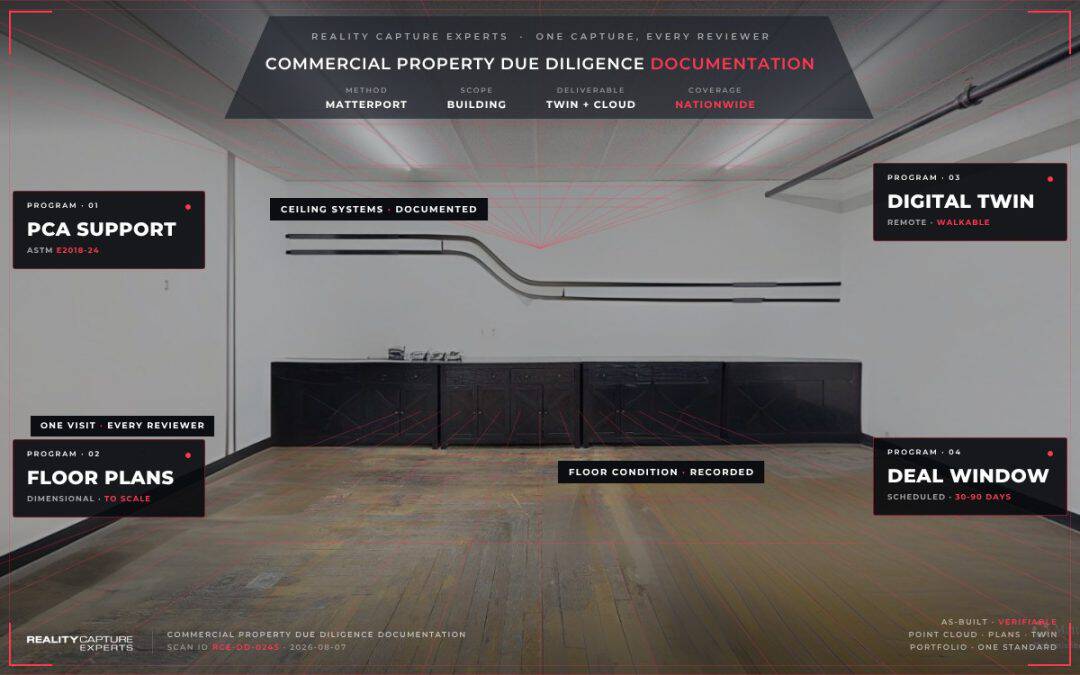
Document a commercial property for due diligence by building a dated, verifiable record of its physical condition, systems, and layout before a deal closes. For a multi-site buyer, lender, or asset manager, that record needs to stay consistent across every property in the portfolio and be reviewable without a site visit.
What physical documentation do buyers and lenders actually require?
Most commercial transactions require a property condition assessment (PCA) built to ASTM E2018-24, supported by photos, floor plans, and often an as-built survey. Lenders use the PCA to size reserves and flag deferred maintenance before it becomes their problem after closing, following assessment standards outlined by Intertek’s property condition assessment guidance.
A PCA consultant walks the site, documents deficiencies, and estimates remaining useful life on major building systems. The report is only as reliable as the underlying record of what the property actually looked like on the day of inspection.
This is where 3D capture fits in. A Matterport scan gives the PCA consultant, the buyer’s internal team, and the lender’s reviewer a shared, walkable record of the same site visit, instead of each party relying on a written report alone.
Why does site-by-site documentation break down on multi-site deals?
A single-property deal can run on one inspector’s notes and a folder of photos. A portfolio deal covering 12, 40, or 200 properties cannot – the moment documentation quality depends on which vendor showed up to which site, the buyer’s risk picture gets inconsistent.
A site-by-site vendor approach – hiring whichever local photographer or contractor is available near each property – produces exactly that problem: different equipment, different file formats, and different QC standards from property to property, with no one accountable for the whole set. Due diligence checklists like PropertyMetrics’ real estate due diligence checklist assume that same level of consistency across every property in scope.
RCE’s approach is a coordinated program for capturing a multi-site commercial portfolio: one point of contact schedules and manages every site visit nationwide, one QC standard applies to every scan, and every deliverable – point cloud, floor plan, Matterport digital twin – comes back in the same format regardless of which market the property sits in.
How does 3D capture fit into a due diligence timeline?
Due diligence periods on commercial deals typically run 30-90 days. Capture needs to happen early enough that the PCA consultant, environmental reviewer, and space planning team can all work from the same data instead of scheduling separate site visits.
A single Matterport scan of a property, captured in one site visit, gives every downstream reviewer a walkable 3D record – see how virtual tours support CRE due diligence – dimensionally accurate floor plans, and a raw point cloud that CAD and BIM teams can build from later in the process.
For a multi-site deal, RCE schedules capture across every property against a shared timeline, so the buyer is not waiting on the slowest site to close out its physical documentation before the deal can move forward.
What does a coordinated capture program look like across a portfolio?
A coordinated program starts with a single scope: what LOD (level of development) or LOA (level of accuracy) the deal requires, and which sites need full Scan-to-BIM versus a Matterport digital twin and floor plan.
RCE manages field scheduling, equipment, and QC review centrally, then delivers point clouds, floor plans, and BIM/CAD files back through one point of contact – so the buyer’s team is not managing individual vendors, invoices, or file formats site by site.
That matters most inside the deal window: a Director of Real Estate or Portfolio Manager reviewing a 40-site acquisition should not need to track down six different local capture vendors just to get a status update.
How do you turn capture data into documents reviewers can use?
Raw capture data only helps if it turns into something the deal team can act on: a floor plan attached to the PCA report, a point cloud a structural engineer can measure from, or a Matterport link a lender’s reviewer can walk through remotely.
RCE delivers Matterport digital twins alongside 2D floor plans, CAD files, and, where the deal calls for it, Scan-to-BIM output at the LOD the buyer’s architecture or engineering team specifies.
That combination lets a buyer’s team, their PCA consultant, and their lender’s reviewer work from the same as-built record instead of three separate site visits and three separate sets of files. This becomes especially important when an as-built survey before a commercial acquisition is also part of the closing requirements.
Frequently Asked Questions
Is a Matterport scan a substitute for a property condition assessment?
No. A Matterport scan documents the physical as-built condition and layout of a property; a PCA is a professional opinion on deficiencies, remaining useful life, and repair costs. Capture data supports the PCA consultant’s fieldwork – it does not replace their report.
How long does capture take for a single commercial property?
A typical site visit runs a few hours depending on square footage and site complexity. Multi-site portfolios are scheduled as one coordinated program so every property is captured against the same due diligence timeline.
What deliverables come out of a due diligence capture?
A Matterport digital twin, dimensionally accurate floor plans, and the raw point cloud. CAD and BIM outputs are available where the deal requires Scan-to-BIM documentation at a specified LOD.
Can a lender’s reviewer use the capture data remotely?
Yes. The Matterport digital twin lets a lender’s or buyer’s reviewer walk a property remotely, take measurements, and review layout and condition without a second site visit.
How is this different across a multi-site portfolio versus one property?
Coordination is the difference. RCE manages scheduling, equipment, and QC centrally through one point of contact, so a 40-site portfolio comes back in a consistent format instead of depending on which local vendor covered which site.
What Happens Next
Once a buyer or asset manager knows which properties need documentation, RCE scopes the capture requirements per site, confirms LOD/LOA with the buyer’s technical team, and schedules field operations against the due diligence timeline. Point cloud, floor plans, and Matterport digital twins are delivered through one point of contact, with consistent QC across every property in the deal.