
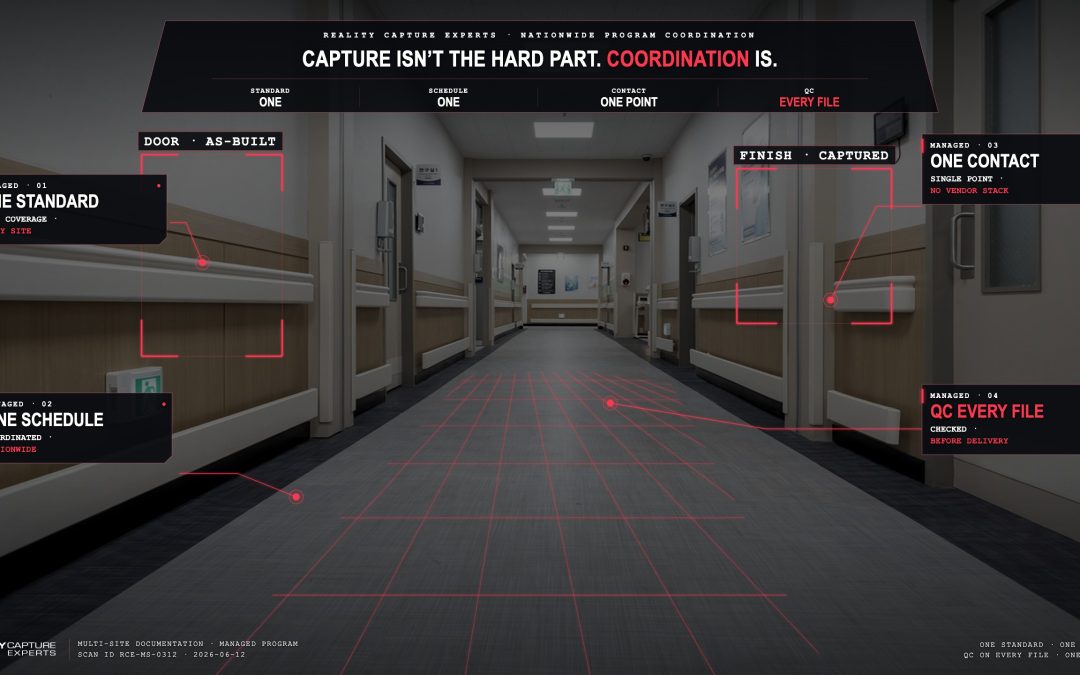
Managed, multi-site Matterport-to-as-built capture — coordinated nationwide, consistent from the first site to the last.
A multi-site as-built capture program runs on a dedicated project manager, one SOP, one QC team, and one delivery standard applied to every site without exception. Centralized coordination is what holds the consistency. Local-vendor patchwork is what breaks it. Everything else is execution detail on top of that foundation.
This post walks through how to plan, mobilize, and deliver a multi-site capture rollout — and where the failures show up at scale.
What Does a Coordinated Matterport 3D Reality Capture Program Look Like?
Five operational pieces hold a multi-site program together:
- A master site list — address, square footage, access instructions, approved capture hours, and point of contact.
- A master schedule, with capture windows aligned to access and any client black-out dates.
- A national field network — vetted operators trained on the same SOP, deployed by region.
- A centralized QC team reviewing every scan against a single checklist before release.
- A single delivery dashboard or tracker, so the client always knows where every site stands.
These five pieces are the operating system of a multi-site program. Each one is a coordination function, not a scanning function. They are what differentiate a managed program from a series of local vendor engagements.
How Do You Roll Out As-Built Capture Across a Large Portfolio Without Losing Consistency?
You stage the work in waves, not all at once. RCE runs multi-site capture as a coordinated program with operators positioned across the country — so a rollout isn’t one crew driving from market to market. Multiple operators deploy at the same time, in different regions, on the same program and the same SOP — which is what keeps quality consistent from the first site to the last, whether a program covers a handful of locations or an entire national portfolio. We’ve delivered rollouts at the top end of that range, and we’ve done it before.
The waves aren’t about where the field team can be — operators can be in many places at once. They’re about pacing the work so capture and modeling stay in step: capture is released in waves so finished scans flow into the modeling queue at a rate the team can clear. That keeps the program on a steady cadence instead of spiking and stalling.
Why Stage a Rollout in Waves Instead of Modeling It All at Once?
Because the constraint isn’t field coverage — it’s modeling throughput. With our nationwide reality capture operations, we can deploy across the country at the same time, so capture moves fast and wide What can’t be rushed is the modeling: a modeling team can’t productively absorb every raw scan in a single drop. Staging capture in waves matches the flow of finished scans to what modeling can clear, so the queue is always fed at a workable rate and nothing piles up. The result is a reliable, predictable pace across every location, no matter how many there are.
How Do You Maintain a Single Standard Across a National Field Network?
A single standard is held through three things: a published capture SOP, an onboarding process for each technician prior to first site visit, and a centralized QC team that reviews every scan before release.
The SOP covers site access, scan pattern, scan density, and any client-specific requirements (e.g., infection control in healthcare, after-hours in retail). The onboarding process puts every operator through a calibration capture against the SOP before they are deployed on client work. The QC team reviews every scan against the same checklist, regardless of which operator captured it.
That is what holds the consistency. Local operators following local conventions is what breaks it.
How Should QC Work in a Multi-Site Program?
QC in a multi-site program is centralized. One team reviews every scan against the same checklist, so the last site in a rollout is held to the same standard as the first. QC runs in three stages — in the field, at modeling hand-off, and at final delivery — and a site doesn’t advance until it clears the stage it’s in.
In the field. Before the crew leaves a site, the capture is checked against the planned scan path: every required area is accounted for, with nothing missed against the scope set for that location. Catching a gap while the operator is still on site is the difference between a quick re-scan and a return trip across the country.
At post-production and modeling hand-off. Anything flagged in the field is written up as a follow-up note, so it travels with the scan instead of getting lost. The scans then move into the modeling queue with those notes attached and the scope and LOD confirmed, so the modeling team builds to the right level the first time.
At final delivery. The finished deliverable is checked against the agreed scope, LOD, and format before it reaches the client, and the model is set up for hosting so it’s ready to use on handover.
QC sign-off happens before the data is released to the modeling team. If a scan fails QC, the field team is re-deployed before the wave closes — so the rework cost is contained.
How Do You Coordinate Access at Scale?
Access coordination across a large portfolio is a full role on the program team. The work covers:
- Per-site point-of-contact identification and confirmation.
- Pre-capture briefing of the on-site contact — what to expect, how long, any prep.
- Scheduling capture inside the site’s available window — including after-hours, weekends, and infection-control-compliant slots in healthcare.
- Confirming security or visitor protocols.
- Letter of authorization with corporate letter head and stakeholder contact information.
- Confirming any pre-capture site prep (e.g., ceiling tiles removed in critical MEP zones).
On a managed program, this is owned by the program PM and tracked in the same dashboard as capture status. On a DIY program, the client owns this for every site — and it is where most rollouts stall.
What Should the Delivery Package Look Like at the Portfolio Level?
Our Matterport to CAD and Matterport to BIM portfolio-level delivery has three layers:
- Per-site deliverables — point cloud, Matterport twin, CAD or BIM file, and utility data in a consistent folder structure and naming convention.
- A portfolio-level index on the RCE project dashboard, showing status across every site.
- Portfolio analytics where applicable — total sites scanned to date, total modeled, completion percentage, sites flagged with access issues, and any open QC items.
That portfolio view is what makes a multi-site program useful at the executive level. Without it, the client has a folder of scans. With it, they have a managed dataset.
Where Do DIY Muti-Site As-Built Capture Models Break Down at Scale?
DIY capture works at single-site scale. At portfolio scale, the failure pattern is consistent: coordination overhead exceeds capture cost, format drift across vendors makes the dataset hard to use, QC is uneven because there is no central reviewer, and the client’s in-house team is doing program management instead of their actual job.
A managed program absorbs that overhead into a single workflow. The client sees one PM, one schedule, one delivery, one invoice. The capture work disappears into the program, which is what the client actually wants.
How Reality Capture Experts Runs Multi-Site As-Built Capture
RCE runs multi-site capture as a managed national service. One PM owns the program end-to-end. Field operators deploy from a vetted national network trained on the same SOP. QC runs centrally on every scan before release. Delivery uses a consistent format and folder structure across every site. The client gets a single dashboard showing program status and a single point of contact.
That model is the operational reason RCE can run a program at any scale — from a handful of locations to an entire national portfolio — at consistent quality and predictable cost.
What Happens Next
A multi-site as-built capture program scopes in two stages: a conversation to confirm site count, deliverables, and timeline; followed by a written program scope with per-site scoping documents and a master schedule. Capture begins as soon as access is coordinated. Everything after that runs on the same operating system — scheduling, on-site capture, post-production, modeling, and delivery.
FAQ
Is there a limit to how many sites RCE can take on?
There’s no fixed ceiling on the RCE side. Programs are wave-staged across a national field network, so the practical limit on any rollout is how quickly access can be coordinated and sites made ready — not capture or modeling capacity.
How is consistency maintained across operators?
A published SOP, an onboarding calibration capture for every new operator, and centralized QC on every scan before release.
What if a site has unusual access constraints?
Unusual access — after-hours, infection control, secured government, occupied retail — is scoped into the per-site capture plan at the start of the program. The schedule is built around the access window.
Can the program scope grow mid-rollout?
Yes. Adding sites mid-rollout is straightforward because the SOP, QC, and delivery format are already in place. New sites are scoped into the next wave.
Interested in learning more about how RCE can support your team by providing multi-site as-built capture for your portfolio? Start Here.