
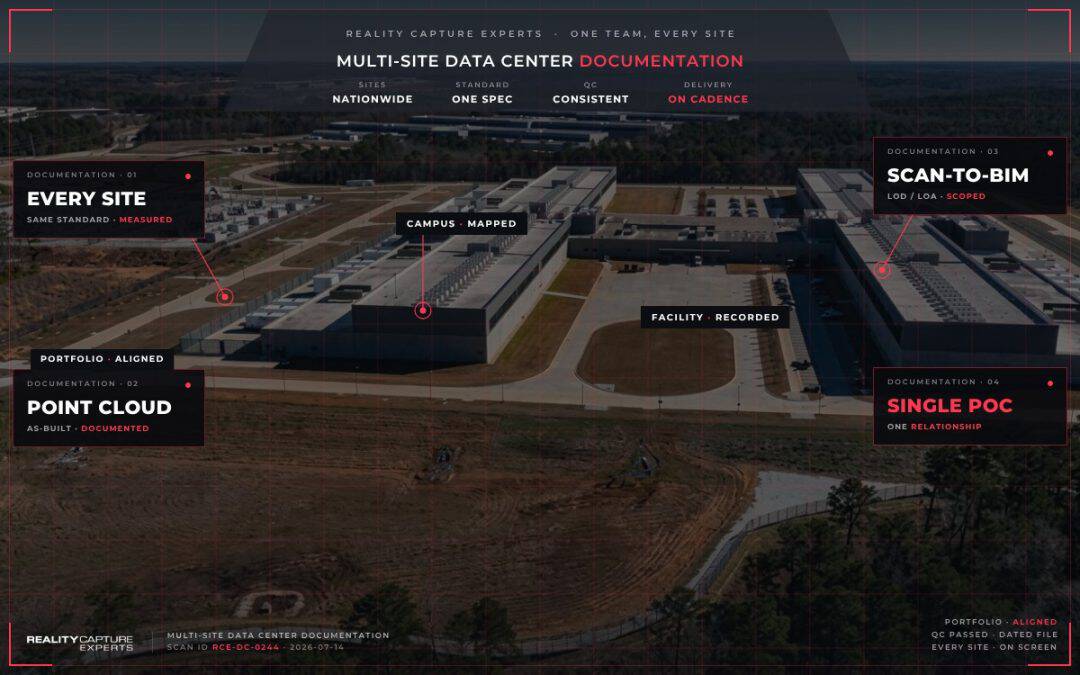
Multi-site data center documentation stays consistent when you run capture as one managed program: a single point of contact, one written capture standard, and one QC process applied to every location. That is what makes a file from one site read the same as a file from another, so any team member can open any site’s records and know where to look.
Standardization is the whole game for a portfolio operator, and it is what quietly falls apart when each site is handled on its own. This guide explains why multi-site data center documentation fragments and what holds it together. It puts the scaling theme from our pillar on reality capture for data centers into practice.
Why multi-site data center documentation fragments
It fragments because each site tends to be handled as its own project, by its own vendor, on its own timeline. One site uses one naming convention; another uses a different one. Deliverables do not align. Individually each might be fine; together they are not a portfolio you can operate against. The gap shows up at the worst moment, when someone is working an abnormality and needs accurate as-built information now, but that site’s record looks nothing like the one they trained on.
What the do-it-yourself path leaves on your desk
In a self-serve model, standardization is your job. You buy cameras or hire operators site by site, manage each vendor, and reconcile inconsistent deliverables. You own the QC and the naming discipline across every location, and that load grows with every site. Where the self-serve path leaves you managing scanning, operators, and vendors location by location, a managed program delivers one consistent standard across all of them.
What it takes to standardize multi-site data center documentation
Four things. First, a single point of contact who owns the program across all sites. Second, a written capture standard covering scan density, scope, and file formats, specified once and applied everywhere. Third, a consistent QC process that checks every deliverable before it reaches you. Fourth, a consistent naming and delivery structure so any site’s files are navigable without a translator. Those four turn a set of individual scans into a portfolio-wide documentation asset.
How standardization helps capacity planning
It makes asset data trustworthy everywhere. Capacity planning depends on accurate asset data such as dimensions, port and connector types, and exact cabinet locations, and bad data throws off reservations and change requests. When every site is documented to the same standard, a planner compares like with like instead of reconciling three conventions first. That consistency also keeps the commissioning-to-operations handoff clean, which we cover in data center commissioning documentation. Facilities that follow Uptime Institute operations practices treat this consistency as a requirement, not a nicety.
Frequently Asked Questions
Why not hire a local vendor at each site?
You can, but then standardization is your job. Different vendors deliver different formats, and reconciling them into a consistent portfolio record is an ongoing load.
What makes multi-site data center documentation standardized?
One written capture standard, one QC process, and one naming and delivery structure applied at every location.
Can one provider cover sites in multiple states?
Yes. RCE delivers managed capture nationwide under one point of contact, with the same standard and QC at every location.
How does it help capacity planning?
It makes asset data comparable across sites, so planners compare like with like.
How RCE handles this
RCE runs multi-site data center documentation as one program: set the capture standard once, coordinate access and field teams across every location, apply the same QC to every deliverable, and deliver in a consistent structure. You stay in one conversation with one point of contact, and the documentation reads the same whether the site is in Virginia, Texas, or Oregon. For the full managed-capture picture, see our pillar on reality capture for data centers.