
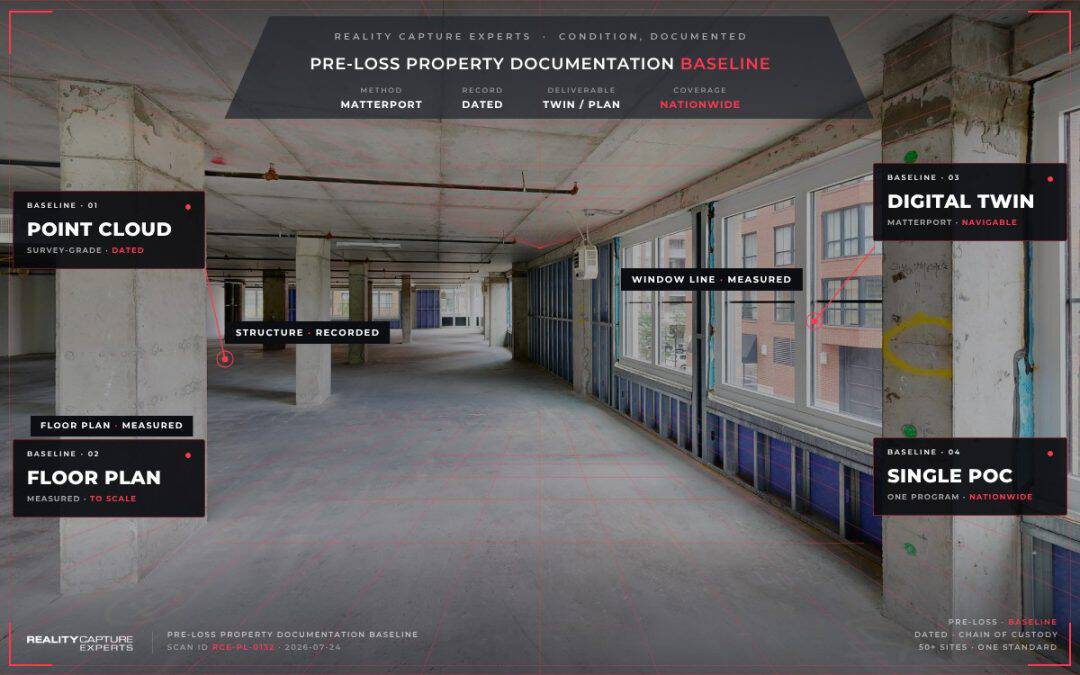
A pre-loss documentation program for multi-site portfolios starts with a defined scope (which sites, what coverage, what accuracy standard), then runs capture as a coordinated schedule rather than a site-by-site favor. A pre-loss documentation program for multi-site portfolios treats documentation as an ongoing operational habit, delivered by one team to one standard, instead of a stack of individual vendors and formats.
What does it take to stand up a program instead of a one-off scan?
Three things: a defined scope (site list, coverage requirements, accuracy target), a single point of contact who owns scheduling and QC, and a delivery format that’s consistent across every site so a risk team reviewing site 4 and site 40 is looking at the same thing. RCE runs all three as a managed service – one relationship instead of a different vendor at every location.
How do you scope which sites get captured first?
Most portfolios start with highest-value or highest-exposure locations, then extend the same standard as budget and schedule allow. RCE scopes this with the risk or facilities lead up front, so the rollout order reflects actual risk priority rather than whichever site happens to be easiest to schedule first.
What does coordinated scheduling actually look like across a portfolio?
Sites get batched by region so field crews can move efficiently, coordinated through one point of contact rather than each location scheduling separately. A property manager in Ohio and one in Oregon get the same intake process, the same QC checklist, and the same delivery timeline.
How do you keep quality consistent from site 1 to site 200?
One SOP and QC on every deliverable before it’s handed over. When every site is captured to the same coverage and accuracy standard, the documentation is comparable building to building – which matters if a claim or underwriting review ever needs to compare one site’s baseline against another’s.
How often does a program need to refresh its baseline?
Most property condition documentation stays useful for two to three years before renovations, tenant turnover, and ordinary wear move a building far enough from what the original scan shows. RCE ties refresh timing to that cycle, with an earlier recapture triggered by any major renovation, tenant change, or capital project rather than waiting for the standard interval – see the companion post on documentation refresh cadence for the full breakdown.
Frequently Asked Questions
Do we need to document every site, or just the highest-value ones?
That’s a risk decision. Many portfolios start with their highest-value or highest-exposure locations and extend the same standard as the program scales. RCE can scope either approach.
Who manages scheduling and access at each site?
RCE does, through a single point of contact who coordinates with each location so your team isn’t chasing operators or calendars across the portfolio.
Does a program like this replace individual site inspections?
No, it supports them. An inspection captures observations and professional judgment; the documentation program gives those observations something measurable to reference.
How long does it take to get an initial baseline in place portfolio-wide?
Timeline depends on site count and geography. RCE scopes a rollout schedule during onboarding and sequences capture regionally to keep the timeline realistic.
Can this work if some sites already have documentation and others don’t?
Yes. RCE can bring existing sites up to the same standard while capturing new baselines for sites that don’t have one yet, so the portfolio ends up consistent either way.
What Happens Next
RCE scopes the program first: site list, coverage at each location, accuracy standard, and rollout timeline. From there we coordinate scheduling with each site’s point of contact, run capture to one SOP nationwide, and QC every deliverable before it’s part of the record. The owner manages one relationship instead of a portfolio of separate vendor relationships.
This week’s series also covers what a pre-loss 3D survey should actually capture at each site, who should hold custody of property documentation during a claim, how to document property damage before restoration begins, and how often to update property condition documentation.