
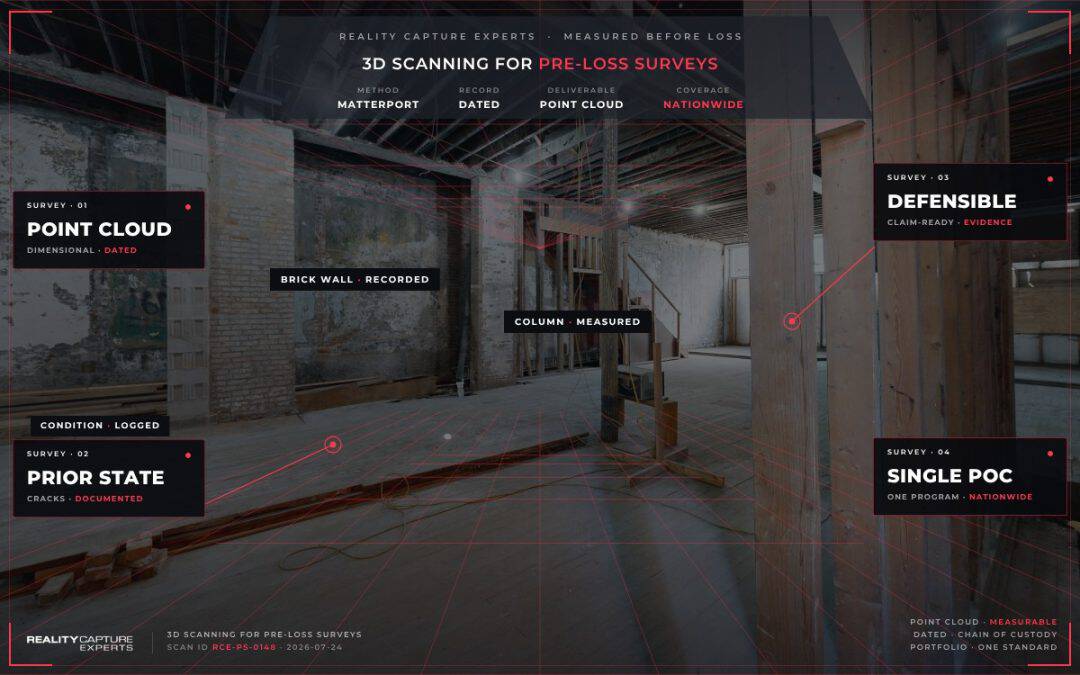
3D scanning for pre-loss surveys works by capturing a measurable, dated point cloud of a property’s condition before a loss occurs. Instead of relying on photos and memory, a risk or facilities team gets a spatial record accurate enough to reference months or years later, room by room, across every site in a portfolio.
What does a 3D scan actually capture that photos don’t?
A point cloud captures dimension and spatial relationships, not just appearance. It shows cracking, settlement, or existing wear at a level of measurable detail a photo can’t match. When an insurer questions whether damage is new, a point cloud can show the exact prior condition of a wall, ceiling, or mechanical system – not just what it looked like in a snapshot, but its precise position and geometry on the capture date.
How does this work across a multi-site portfolio?
RCE coordinates capture across every location under one point of contact, so a portfolio spread across multiple states gets consistent coverage instead of a patchwork of vendors and formats. Sites are scheduled in regional batches, captured with the same equipment standard, and delivered through the same QC checklist and file structure – so a risk manager reviewing documentation for site 4 and site 40 is looking at the same thing. This consistency matters especially for organizations managing a mix of owned and leased locations, where individual property teams might otherwise select different vendors, equipment, and file formats without central coordination.
What should be captured during a pre-loss survey scan?
A complete pre-loss scan covers full interior walkthrough coverage, mechanical and electrical rooms, any area with prior claims history, and exterior conditions where accessible. The scan should be dense enough to measure from later and time-stamped in a way that can’t be altered after the fact. Capturing at this level of completeness also gives facilities teams reference material for space planning and maintenance scheduling, beyond the insurance use case alone.
Does this replace a traditional property inspection?
No. It supplements one. An inspector’s written report captures observations and professional judgment; the point cloud captures the spatial record those observations reference. Insurers and adjusters use both together, and a documented scan gives an inspector’s notes something concrete to point back to.
How does 3D scanning for pre-loss surveys fit into a broader risk management program?
3D scanning for pre-loss surveys works best as one input among several a risk management program relies on, alongside insurance policy reviews, safety audits, and maintenance records. The scan data doesn’t replace those processes; it gives them a consistent, dated spatial reference so property condition claims can be verified quickly rather than debated from memory.
What happens next / How RCE handles this
RCE schedules pre-loss surveys as part of a coordinated capture calendar, batching nearby sites to keep timelines tight and standards consistent. Each site gets a Matterport digital twin, measured floor plan, and dated file archive delivered to the client’s system of record, with QC review before delivery so every site meets the same bar regardless of who was on-site that day.
For the broader documentation program this fits into, see what a pre-loss property documentation program includes for multi-site portfolios.
FAQ
How long does a pre-loss scan take per site? It depends on square footage and site complexity; RCE scopes capture time during onboarding so a portfolio-wide schedule can be built with realistic timelines.
Can this be done alongside a routine facilities inspection? Yes, and many clients coordinate the two so field access is scheduled once.
Is the point cloud data usable for anything besides insurance? Yes – the same capture supports facilities planning, space documentation, and renovation scoping.
What if a site has restricted or hazardous areas? RCE’s field teams follow site-specific access protocols and document what’s safely accessible, noting any areas excluded from capture.