
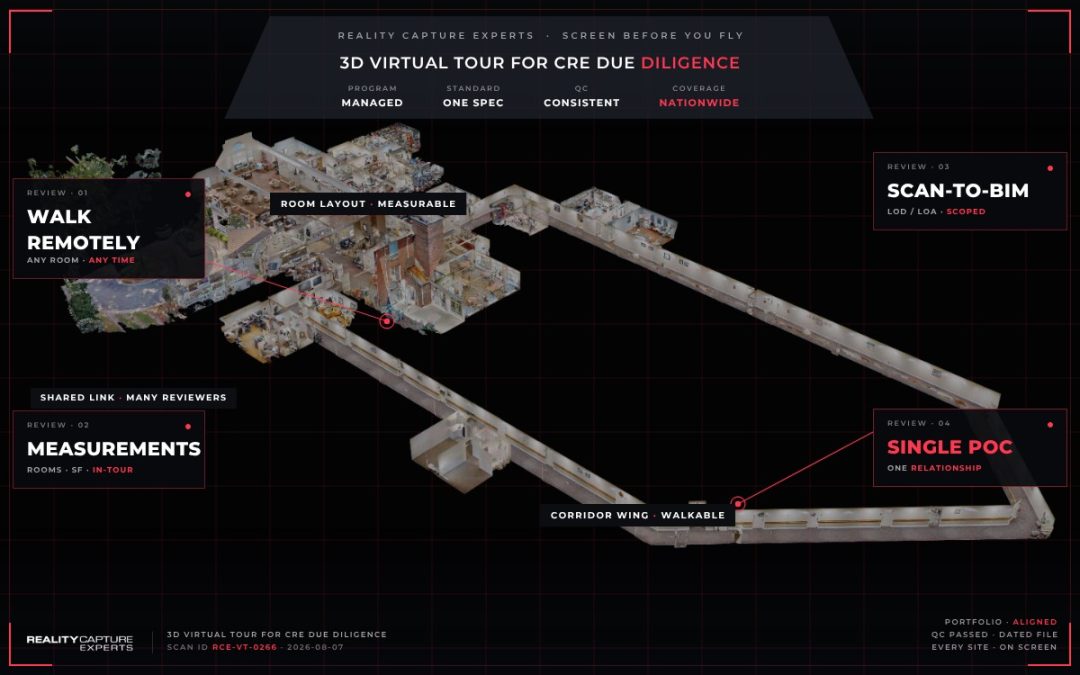
Virtual tours CRE due diligence programs give buyers, lenders, and internal reviewers a walkable, measurable Matterport record of a property before anyone has to travel to the site. That speeds up early-stage screening and cuts down on repeat in-person visits across a portfolio.
What Can a Reviewer Actually Do Inside a Matterport Virtual Tour?
A reviewer can walk each room, take measurements, review floor plans and square footage, and use overhead mode to check layout, circulation paths, and core placement – all without setting foot on-site.
For a multi-site deal, that means a portfolio manager can review 10 properties in an afternoon from a desk, instead of scheduling 10 separate site visits before narrowing the list down. That’s part of why capturing a multi-site commercial portfolio builds virtual tours in as a first screening step, and why more CRE teams now treat the digital twin as their default starting point instead of a nice-to-have add-on.
Industry coverage of 3D virtual tours for commercial real estate points to the same shift: remote-first screening is becoming standard practice on multi-site deals, not a workaround.
Beyond initial screening, the same virtual tour gets reused later in the deal. A space planning team can rough out a tenant improvement layout from the digital twin before the lease is signed, and an internal stakeholder who could not make the site visit can still walk the property on their own schedule instead of waiting on a shared summary from someone else’s trip.
How Much In-Person Travel Does a Virtual Tour Replace?
It does not eliminate in-person inspection, but it changes when travel happens. Teams use the virtual tour to screen and shortlist properties first, then schedule in-person visits only for the sites that clear that first review.
That sequencing matters most on portfolios spread across multiple states, where flying a team to every site before narrowing the list would burn through the due diligence window. A due diligence timeline that typically runs 30-90 days does not leave much room for travel that a five-minute desk walkthrough could have avoided.
On a 20-site portfolio spread across five states, that can mean the difference between one round of targeted site visits and five separate regional trips. The virtual tour does not decide which properties still need a person on the ground – it just moves that decision earlier, so travel gets spent on the sites that actually need it.
Is a Virtual Tour a Substitute for a Physical Inspection?
No. A virtual tour documents layout, dimensions, and visible condition; it does not replace a licensed inspector’s or engineer’s on-site evaluation of structural, mechanical, or life-safety systems. The two are complementary, not interchangeable.
Where a PCA or structural review is required, the virtual tour gives that consultant a reference to walk through before or after their visit, not a replacement for being there. The same logic applies to an as-built survey before a commercial acquisition – the tour supports the surveyor’s fieldwork, it doesn’t replace it.
Guides like Yardi’s commercial real estate due diligence guide draw the same line: remote review tools speed up screening, but licensed inspections and surveys still carry the legal and financing weight.
How Do Virtual Tours CRE Due Diligence Programs Work Across a Portfolio?
RCE schedules Matterport capture for every property in a portfolio through one coordinated program, then delivers each digital twin with matching floor plans and point cloud data, so every property in the deal is reviewable in the same format. This is the same standard RCE applies when documenting a commercial property for due diligence.
That consistency is what lets a reviewer compare property 4 to property 40 without adjusting for a different vendor’s camera, file format, or walkthrough style. One coordinated program, delivered through one point of contact, is what makes virtual tours for CRE due diligence usable at portfolio scale instead of just on a single asset.
What Should a Buyer Check Before Relying on a Virtual Tour?
Not every digital twin is current or complete. Before treating a virtual tour as a reliable stand-in for a site visit, a buyer’s team should confirm the scan date against the due diligence timeline, check that every space relevant to the deal – mechanical rooms, back-of-house areas, exterior grounds – was actually captured, and verify that floor plans and measurements were generated from the same site visit rather than pulled from older record drawings.
A coordinated capture program addresses this by design: RCE captures the entire scope agreed with the buyer’s team in one visit, so there is no question about whether a given room was skipped or whether the floor plan matches what the camera actually recorded.
What Happens Next
RCE schedules Matterport capture for the properties under review, delivers each digital twin with floor plans and point cloud data, and coordinates timing so early-stage screening does not stall the rest of the due diligence timeline.
Frequently Asked Questions
Can a lender rely on a virtual tour alone?
No. Lenders still require a PCA and, where applicable, an as-built survey. The virtual tour supports those processes; it does not replace them.
How long does it take to get a virtual tour after capture?
Turnaround depends on property size and portfolio volume; RCE coordinates delivery timing against the buyer’s due diligence schedule.
Can multiple reviewers access the same virtual tour at once?
Yes. The Matterport digital twin is shared through a link, so the buyer’s team, the PCA consultant, and the lender’s reviewer can each review it independently.
Does a virtual tour include measurements?
Yes. Matterport’s measurement tools let a reviewer check room dimensions and square footage directly inside the digital twin.