
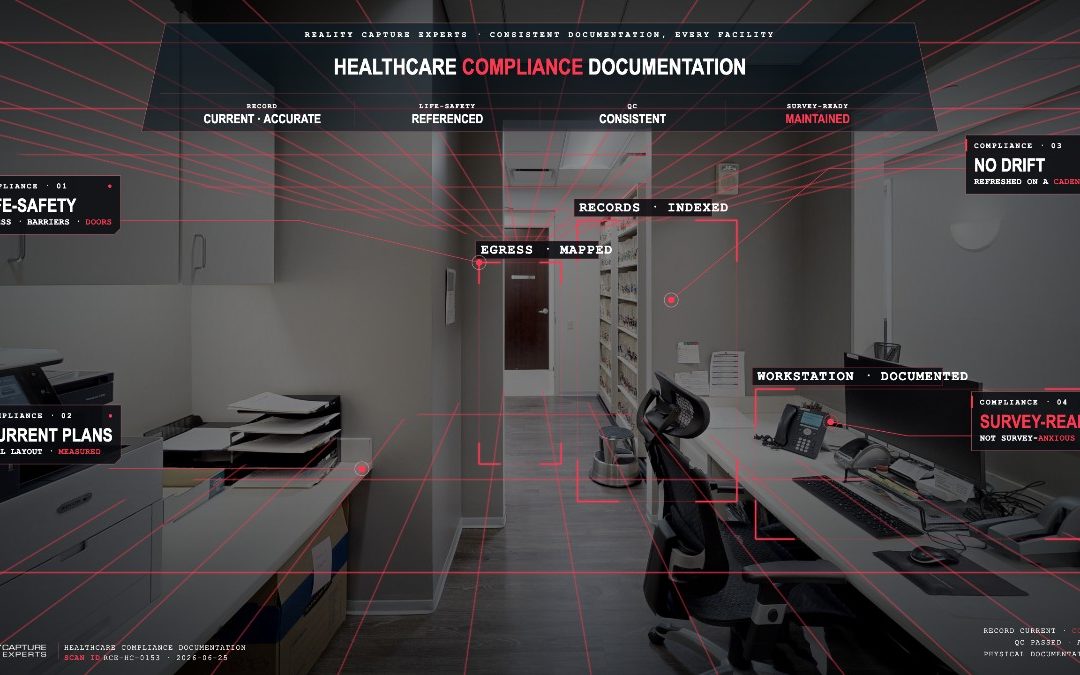
Healthcare compliance documentation depends on current, accurate records of physical conditions – floor plans, life-safety layouts, and a reliable record of how spaces are actually built – so facilities stay ready for audits and surveys. A managed capture program keeps healthcare compliance documentation consistent across every facility, so compliance and safety teams are not scrambling before a survey.
Why does healthcare compliance documentation matter?
Documentation matters because regulators increasingly cite facilities not just for conditions, but for failing to prove those conditions were known, assessed, and managed. The record is part of compliance, not separate from it.
Across the industry in 2026, documentation failures are generating a large share of enforcement activity – facilities cited for not showing that inspections happened, that deficiencies were identified, and that corrective actions were completed. Accurate as-built documentation is the foundation that life-safety, environment-of-care, and capital records sit on. If the underlying record of the building is wrong, everything built on it is suspect.
What kinds of documentation are involved?
Compliance touches several documentation types, and accurate as-builts support most of them.
Life-safety drawings depend on knowing the real layout – egress paths, fire and smoke barriers, door locations. Environment-of-care and facility records depend on knowing what is actually in the building. Capital and maintenance planning depends on accurate conditions across the portfolio. A current Matterport model and floor plans give safety and facilities teams a reliable, visual reference for all of it, and a measured point cloud backs it with accuracy.
RCE does not provide regulatory or legal advice, and the specific records a facility must keep are set by its accreditors and authorities having jurisdiction. What RCE provides is the accurate physical documentation those records are built from.
How does documentation drift become a compliance risk?
Documentation drifts every time a space changes and the record does not, and across a multi-site system that drift compounds into risk.
A renovation finishes and the drawings are not updated. A barrier moves and the life-safety drawing still shows the old one. Multiply that across dozens of buildings, each tracking changes differently, and the system loses confidence in its own records. When a survey is scheduled, teams scramble to confirm conditions that should already be documented.
How does a managed program keep facilities survey-ready?
A managed program keeps documentation current and consistent on a schedule, so the record reflects the building instead of lagging behind it.
RCE captures every facility to the same scope and QC, and keeps healthcare compliance documentation current on a cadence the system sets. Because one team owns the program nationwide, a facility in one market is documented to the same standard as a facility in another. That consistency is what makes a portfolio survey-ready rather than survey-anxious, and it is the same backbone behind the broader as-built documentation program. When documentation needs to be refreshed after a project, it connects directly to renovation as-builts.
How does RCE protect PHI while documenting for compliance?
Compliance documentation and patient privacy go hand in hand, so protecting Protected Health Information (PHI) is built into how RCE captures a healthcare facility. We take HIPAA and the protection of PHI seriously, and every engagement runs under our Confidentiality and HIPAA Compliance Policy.
A pre-scanning checklist is completed before capture, identifying where PHI is likely to appear – patient charts, monitors, records, and posted schedules – so operators keep it out of frame. Where PHI cannot be avoided, it is redacted, blurred, or cropped from the final deliverables. Field devices are password protected and encrypted, models and reports are stored on secure, encrypted platforms, and access to any sensitive data is limited to authorized personnel. Where a client requires it, we enter into a Business Associate Agreement (BAA) defining data handling and breach-notification timelines, and our team completes HIPAA awareness training annually, with logs kept for audit purposes.
This matters for compliance because the record itself has to be trustworthy and handled correctly. RCE provides the accurate physical documentation your safety and facilities teams rely on, captured in a way that respects the same privacy standards your facility is held to.
How often should healthcare compliance documentation be updated?
There is no single rule, but healthcare compliance documentation is only useful when it reflects the building as it stands today, so the right cadence is tied to change, not the calendar alone. Every renovation, barrier relocation, equipment change, or department move is a point where the record can fall out of step with reality.
A practical approach is to refresh documentation after any project that alters egress, fire and smoke barriers, mechanical systems, or room use, and to run a scheduled portfolio review at a set interval so nothing drifts unnoticed between projects. For a multi-facility system, that cadence is set once and applied everywhere, so healthcare compliance documentation stays consistent from one campus to the next instead of aging at different rates.
RCE builds that rhythm into the program. We capture after qualifying projects, keep deliverables versioned, and refresh on the schedule your compliance and facilities teams set, all under one point of contact. The result is healthcare compliance documentation that is current when a surveyor arrives, not reconstructed in a scramble the week before.
Frequently Asked Questions
Does RCE handle regulatory compliance for us?
No. RCE provides the accurate physical documentation – Matterport models, point clouds, floor plans – that your compliance and safety teams rely on. Specific regulatory requirements are set by your accreditors and authorities having jurisdiction.
Can accurate as-builts support life-safety drawings?
Yes. Life-safety drawings depend on the real layout – egress, barriers, door locations. Accurate capture gives your team a reliable basis for those drawings.
How do you keep documentation current across many facilities?
RCE captures every site to the same scope and QC and refreshes it on a cadence you set, under one point of contact, so the record stays consistent system-wide.
How is this better than each facility keeping its own records?
Facilities tracking changes on their own produce inconsistent records that drift over time. A managed program keeps documentation comparable and current across the whole portfolio.
What Happens Next
RCE scopes what healthcare compliance documentation each facility needs, captures with Matterport and LiDAR, and delivers floor plans and the records your teams use – all to a consistent QC standard. We keep it current on a cadence you set, with one point of contact accountable across the portfolio, so compliance and safety teams work from a record they trust.