
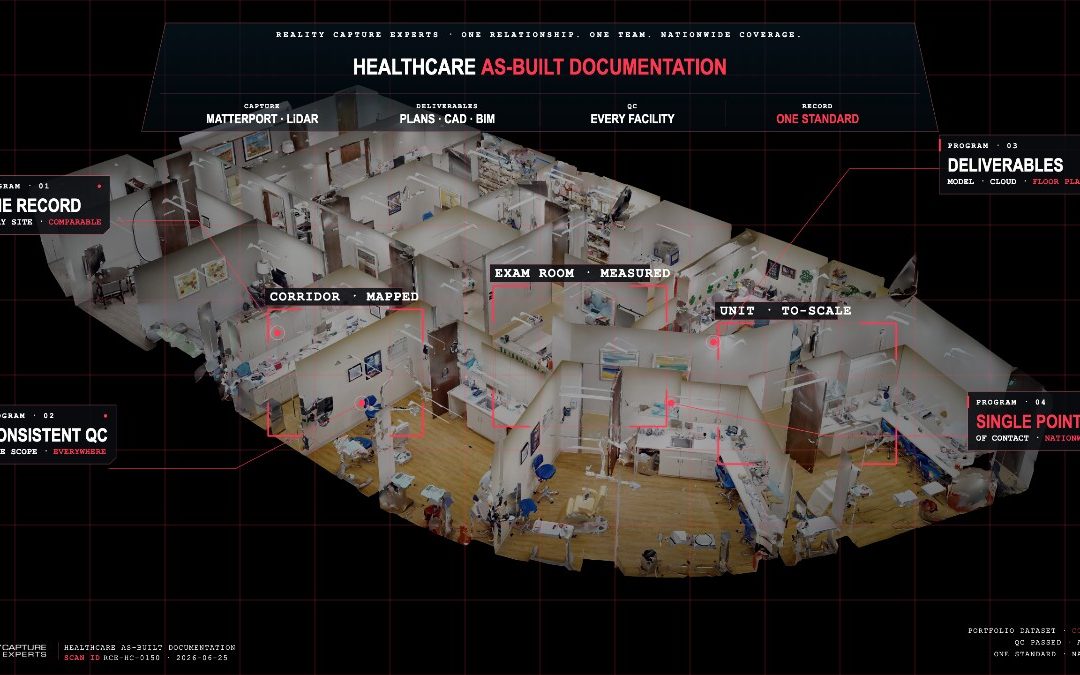
Healthcare as-built documentation stays accurate across every facility when a health system runs one coordinated capture program, instead of leaving each site to scan on its own. A managed Matterport and LiDAR program delivers consistent point cloud data, floor plans, and BIM under a single point of contact, with the same QC everywhere.
What does healthcare as-built documentation mean for a health system?
Healthcare as-built documentation is the accurate, current record of how a building is actually constructed – walls, ceilings, mechanical and electrical systems, equipment, and clearances – as opposed to the original design drawings, which rarely match what was finally built or how it has changed since.
For a health system, that record spans hospitals, medical office buildings, clinics, urgent care, and ambulatory surgery centers, often across many states. Each site has its own decades of renovations, added equipment, and undocumented changes. When facilities, construction, and real estate teams need to plan a project, respond to a regulator, or coordinate a vendor, they need to trust what the documentation says.
The hard part is not capturing one building. It is keeping current, comparable documentation across all of them, with the same accuracy and the same standards, no matter which market the building sits in.
Why is healthcare as-built documentation across many facilities so hard to keep current?
The problem is coordination, not technology. Most health systems already have drawings somewhere. What they lack is a consistent, system-wide record they can rely on.
Drawings drift from reality the moment a renovation finishes. Site teams document changes differently from one market to the next, or not at all. Files live in different folders, formats, and standards. When a project kicks off, the first weeks are spent re-measuring and re-confirming conditions that should already be on record.
When each facility solves this on its own – hiring a local scanning vendor here, sending a facilities tech with a tape measure there – the system ends up with documentation that does not match site to site. That is the do-it-yourself path: every location managing its own scanning, its own operators, and its own vendors. It produces coverage that is inconsistent, hard to compare, and expensive to keep up.
How does a managed capture program solve it?
A managed capture program puts one team in charge of documenting every facility to the same standard, nationwide, under a single point of contact.
Reality Capture Experts coordinates the capture so the health system does not have to. We scope each building against the same requirements, deploy trained on-site operators wherever the facility is, capture with Matterport and LiDAR, and run the same QC on every deliverable before it is handed back. The result is a point cloud, floor plans, and – where needed – BIM that look and behave the same whether the building is in Phoenix or Pittsburgh.
This is the difference between buying scans and running a program. Scans are one-off files. A program is a repeatable process with consistent accuracy, consistent naming, and one owner accountable for coverage across the portfolio.
What does RCE actually deliver for a healthcare as-built documentation portfolio?
We deliver a coordinated documentation program built around how health systems work. That includes:
A single point of contact. One team scopes, schedules, and reports across every market, so facilities and construction leaders are not managing a different vendor at each site.
Consistent capture and QC. Every building is captured to the same scope and checked against the same QC standard before delivery, so a floor plan from one campus is comparable to a floor plan from another.
The deliverables your teams use. Navigable Matterport models for remote walkthroughs, registered LiDAR point clouds for accuracy, 2D floor plans, CAD, and BIM at the level of development your design and construction partners require.
Nationwide coverage. We deploy on-site operators across the country on your timeline, which matters when capital projects and lease events do not wait for one regional crew to become available.
How does healthcare as-built documentation get used day to day?
Healthcare as-built documentation pays off across the facility lifecycle, not just at the start of a renovation.
Capital planning teams use it to scope projects and compare conditions across sites before committing budget. Design and construction partners use the point cloud and BIM to plan renovations against real conditions, which reduces field surprises. Facilities teams use the Matterport model to walk a space remotely, measure clearances, and brief a vendor without flying anyone out. Compliance and safety teams use the documentation as a reliable record when preparing for audits and surveys.
For the deeper renovation and compliance use cases, see how this connects to keeping hospital renovations on schedule and budget and to the documentation healthcare facilities need for compliance.
How do you capture a hospital that is open 24/7?
You capture it on the building’s terms, with operators who plan around patient care and infection-control requirements. Occupied healthcare space cannot be treated like an empty shell.
That means scheduling around clinical activity, respecting ICRA containment where construction or renovation is underway, badging and escort requirements, and clean equipment handling. A managed healthcare as-built documentation program plans these requirements into the scope before anyone arrives on-site, rather than discovering them at the door. We cover the full approach in how to scan an occupied hospital without disrupting patient care.
How do you run this across an entire system instead of one building at a time?
You run it as one program with one owner, one scope standard, and one QC process – applied building by building until the portfolio is covered, then kept current on a schedule. Doing it site by site with separate vendors is what produces the inconsistency in the first place. The managed alternative is laid out in managing capture across a multi-hospital system.
How does RCE protect PHI and patient privacy?
Documenting healthcare space means working around people, care, and Protected Health Information (PHI), so RCE treats privacy as part of the scope, not an afterthought. We take HIPAA and the protection of PHI seriously, and every engagement runs under our Confidentiality and HIPAA Compliance Policy.
Before any operator is on-site, a pre-scanning checklist confirms what to avoid and how to handle it: patient-identifying details, charts, screens, and posted documents are kept out of the capture, and where PHI is unavoidable it is redacted, blurred, or cropped from the final deliverables. Field devices are password protected and models, point clouds, and reports are stored on secure, encrypted platforms.
Where a client requires it, we enter into a Business Associate Agreement (BAA) that defines our responsibilities, data handling, and breach-notification timelines under HIPAA. Every team member with potential access to sensitive information completes HIPAA awareness training annually.
The same discipline applies to the building itself. Operators plan around clinical activity and respect ICRA containment where construction or renovation is underway, so capture never interferes with care. For a health system, that means one healthcare as-built documentation program that protects patients and PHI as consistently as it captures the space.
Frequently Asked Questions
What is the difference between as-built drawings and a Matterport scan?
As-built drawings are 2D records of how a building was constructed. A Matterport scan is a navigable 3D model of the space, and when paired with LiDAR it produces a measurable point cloud. RCE delivers both the visual model and the measured data, plus floor plans, CAD, and BIM derived from the capture.
Can you document our whole health system, not just one hospital?
Yes. RCE is built for multi-site coverage. We coordinate capture across every facility under one point of contact, with consistent scope and QC, so documentation is comparable from site to site.
Do you scan while the hospital is open?
Yes. We schedule around clinical activity and plan for ICRA, badging, escort, and clean-equipment requirements as part of the scope before operators arrive.
What deliverables do we get?
Matterport models, registered LiDAR point clouds, 2D floor plans, CAD, and BIM at the level of development your project requires. We scope deliverables to what your teams and partners actually use.
How is this different from hiring a local scanning vendor at each site?
Local vendors give you one-off files that rarely match site to site. RCE runs a managed program – one owner, one standard, consistent QC nationwide – so your documentation is reliable across the whole portfolio.
What Happens Next
If you are responsible for facilities, construction, or real estate across a health system, the starting point is a conversation about your portfolio: how many sites, where they are, what documentation exists today, and which buildings have projects coming. From there we scope the requirements, propose a capture sequence and timeline, and assign one point of contact to coordinate the work nationwide. You review deliverables against a consistent QC standard, and the documentation stays current on a cadence you set. No site is left to figure out its own scanning.