
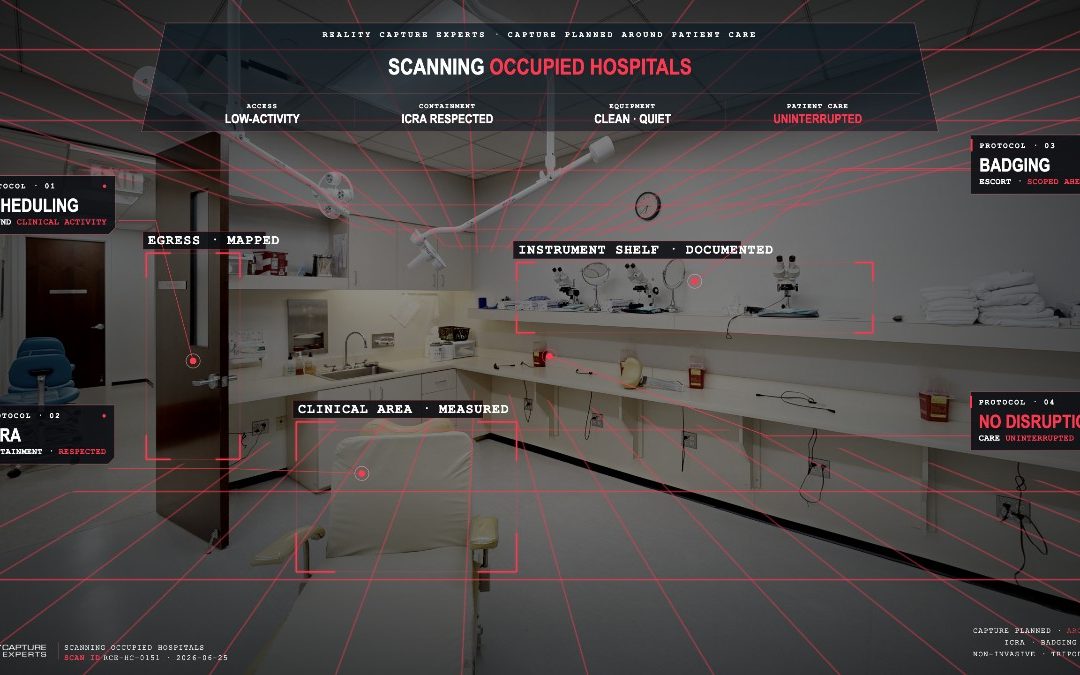
Scanning occupied hospitals starts with planning the capture around clinical activity and infection-control requirements before anyone arrives on-site. That means scheduling during low-activity windows, respecting ICRA containment where renovation is underway, meeting badging and escort rules, and using clean, quiet equipment – all coordinated so capture never interrupts patient care.
Can you really scan a hospital while it is open?
Yes. Scanning occupied hospitals happens every day without disrupting care – the work just has to be planned around the building’s reality instead of treated like an empty construction site.
The capture itself is fast and non-invasive. Matterport and LiDAR operators move through a space the way a person would, with a camera on a tripod, no demolition and no disruption to systems. What makes it work in a hospital is the planning around it: when to be in each area, how to move, and what rules apply where.
What does ICRA have to do with scanning occupied hospitals?
ICRA – the Infection Control Risk Assessment – governs any construction, renovation, or maintenance activity in an occupied healthcare facility, and capture work in or near an active project area falls under it. The ASHE ICRA 2.0 framework sets containment requirements, up to Class IV controls with negative air pressure and rigid barriers for the highest-risk work.
For a capture operator, that means understanding the containment in place before stepping into an area, respecting barriers and pressure boundaries, following the facility’s clean-equipment expectations, and staying out of spaces where access would compromise infection control. A managed program builds these requirements into the scope, so the operator who shows up already knows the rules for that building.
How do you keep capture from interrupting clinical activity?
Scanning occupied hospitals means scheduling around the clinical calendar and sequencing the work so operators are never in the way of care.
That usually means capturing during low-activity windows, working off-hours in clinical zones, coordinating with department managers on timing, and moving through spaces in an order that follows the day’s activity rather than fighting it. Operators badge in, follow escort requirements, and keep equipment compact and quiet. None of this is improvised on the day – it is scoped and scheduled in advance, which is exactly where a coordinated program beats a site arranging its own scan.
Why does the do-it-yourself approach struggle here?
When a single facility hires a local scanning vendor, the vendor often does not know healthcare requirements and the facility ends up managing the compliance details itself.
That is where access problems, missed containment rules, and rescheduled visits come from. A managed capture program handles this differently: the requirements are part of the scope, the operators are briefed on healthcare protocols, and one point of contact coordinates timing with the facility. The hospital is not left training a vendor on its own infection-control rules.
What do you get at the end?
You get a navigable Matterport model and a measurable LiDAR point cloud of the space, captured without disrupting care, ready for floor plans, CAD, or BIM. That documentation then feeds renovation planning, compliance records, and remote coordination – which is why occupied-facility capture is the foundation for a system-wide as-built documentation program.
How does RCE handle PHI while scanning occupied hospitals?
An occupied hospital is full of Protected Health Information (PHI) and active patient care, so scanning it safely is as much about privacy and infection control as it is about capture. RCE takes HIPAA and the protection of PHI seriously, and every job runs under our Confidentiality and HIPAA Compliance Policy.
A pre-scanning checklist is completed before anyone arrives, flagging where PHI is likely to appear – charts, monitors, whiteboards, posted schedules – so operators can keep it out of frame. Where PHI cannot be avoided, it is redacted, blurred, or cropped from the final deliverables. Field devices are password protected and encrypted, and all data is stored on secure, encrypted platforms. Where a client requires it, we sign a Business Associate Agreement (BAA), and our team completes HIPAA awareness training every year.
On the infection-control side, operators respect the ICRA containment in place, follow badging, escort, and clean-equipment rules, and stay out of spaces where access would compromise patient safety. All of it is planned into the scope up front. That combination – PHI protection and ICRA discipline, coordinated by one point of contact – is what lets us document an occupied hospital without disrupting care.
What happens next / How RCE handles this
Before scanning occupied hospitals, RCE scopes the building: clinical schedule, ICRA status, badging and escort requirements, and the areas to capture. We propose a capture window that works around care, deploy a trained on-site operator, and run QC on the deliverable before handing it back. One point of contact coordinates it all, so the facility’s job is to grant access – not to manage the capture.
Frequently asked questions
Will scanning interfere with patient care?
No, when it is planned correctly. Capture is scheduled around clinical activity and sequenced so operators stay out of the way of care, often working low-activity windows or off-hours in clinical zones.
Does scanning meet infection-control requirements?
Capture in or near an active project respects the ICRA containment in place. RCE builds ICRA, badging, escort, and clean-equipment requirements into the scope before operators arrive.
How long does it take to scan a hospital floor?
It depends on size and access, but capture is fast and non-invasive. The schedule is usually driven by clinical access windows, not by the speed of the equipment.
Do operators need to be escorted?
Often, yes. RCE plans for badging and escort requirements as part of the scope so access is arranged ahead of time.