
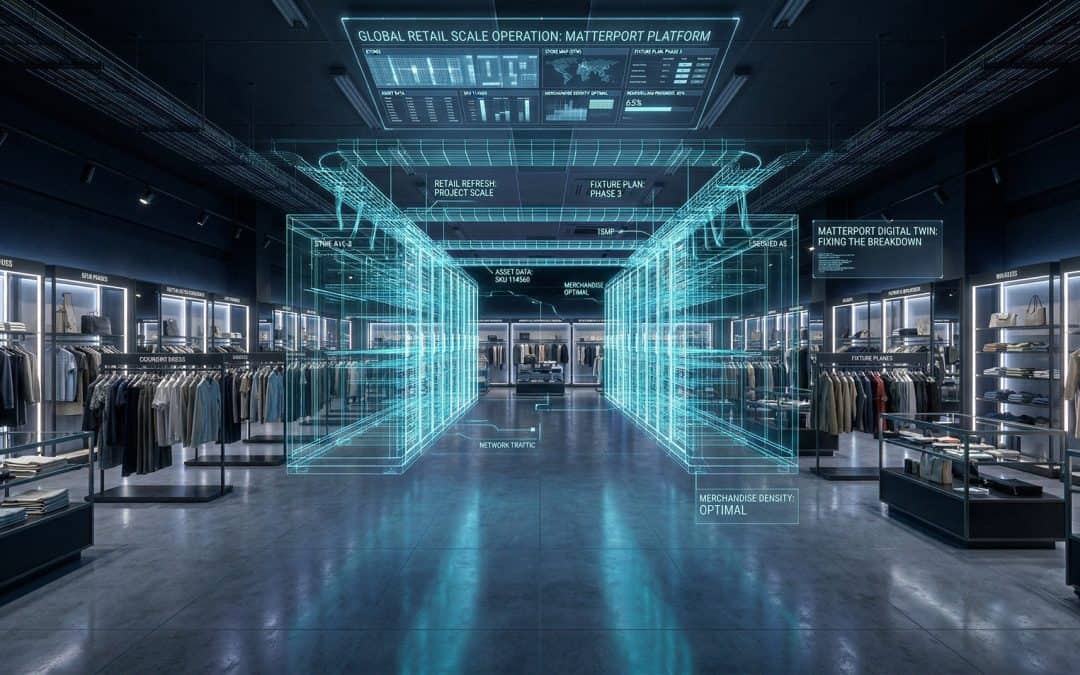
Growth targets continue to rise, but expansion through new locations is no longer the default strategy. Instead, many national and regional brands are betting on store refreshes, rebrands, and targeted improvements to drive higher foot traffic, stronger brand perception, and improved customer retention—without increasing their footprint.
On paper, it sounds straightforward. In practice, it rarely is.
The reality before digital twins: ambition meets operational friction
A typical large-scale refresh initiative might include:
- Hundreds of active stores
- Multiple internal departments
- Outside architects, contractors, and vendors
- Aggressive timelines
- Fixed capital budgets
Store Planning and Construction teams are asked to modernize locations quickly, improve brand consistency, and reduce disruption to daily operations—all while coordinating with Facilities, Real Estate, Operations, and Marketing.
The biggest obstacle is not execution. It’s information.
Common problems retail teams face
Across retail portfolios, the same issues surface repeatedly:
1. Fragmented site data
- Floor plans that don’t match existing conditions
- Missing or outdated measurements
- Inconsistent documentation across regions
- Photos with no spatial context
Teams end up relying on PDFs, spreadsheets, emails, and phone calls to piece together site conditions—often with conflicting answers.
2. Too many site visits
- Architects request clarifications
- Facilities teams flag unknown utilities
- Contractors submit RFIs
- Project managers schedule return visits
Each additional visit costs time, travel, labor, and momentum.
3. Poor visibility into hidden conditions
- Electrical panels and risers
- HVAC units and roof access
- Water, gas, and fire suppression systems
- Ceiling conditions and obstructions
These gaps often surface mid-construction, when changes are most expensive.
4. Departmental silos
- Real Estate focuses on asset value
- Facilities manages utilities and maintenance
- Construction needs accurate dimensions
- Brand & Marketing cares about signage and finishes
Without a shared reference point, alignment breaks down.
The shift: using Matterport digital twins as a single source of truth
To solve these challenges, retailers are increasingly turning to Matterport digital twins as the foundation for store refresh and improvement programs.
Instead of treating site documentation as a one-off task, digital twins create a living, visual record of each location—accessible to every stakeholder.
What a Matterport digital twin provides
1. Spatial accuracy
- True-to-scale 3D capture of the interior and exterior
- Measurable dimensions without site visits
- Consistent capture standards across locations
Teams can confidently plan layouts, fixtures, and construction scopes remotely.
2. Visual context (not just photos)
Unlike static images, a digital twin:
- Shows how spaces connect
- Allows stakeholders to move through the store naturally
- Provides orientation and scale instantly
This dramatically reduces misinterpretation.
3. Utility & asset visibility
Matterport tours can include tags and labels for:
- Electrical panels
- Water and gas meters
- Fire riser rooms
- Roof access points
- HVAC equipment
- IT and security infrastructure
This information is available before design and construction begin, not after problems arise.
4. Centralized access
Instead of files scattered across systems, teams access:
- One link per store
- One standardized experience
- One shared reference
Everyone—from executives to contractors—works from the same data.
Cost, time, and risk: where the real savings come from
Reduced planning costs
Traditional site evaluations often require:
- Multiple third-party consultants
- Travel expenses
- Repeat visits
- Manual reporting
Digital twins significantly reduce or eliminate these costs by enabling remote review, measurement, and coordination.
Faster timelines
When teams have accurate information early:
- Designs move forward faster
- Fewer RFIs are issued
- Construction schedules stabilize
Retailers regularly report months saved across refresh programs when digital twins are implemented at scale.
Fewer change orders
Most change orders stem from surprises:
- Unknown utilities
- Conflicting measurements
- Missed constraints
By documenting existing conditions clearly, Matterport reduces uncertainty—and uncertainty is expensive.
Supporting the full retail improvement lifecycle
Matterport digital twins are not limited to remodels. They support the entire store lifecycle, including:
Pre-construction & planning
- Site readiness reviews
- Existing condition verification
- Scope validation
Construction & refresh
- Remote coordination
- Contractor alignment
- Progress verification
Facilities & operations
- Maintenance planning
- Asset documentation
- Reduced dependency on tribal knowledge
Brand & marketing
- Visual audits
- Signage planning
- Consistency across locations
Why this matters now
Retail is moving away from reactive decision-making. Just as CRMs transformed customer management, digital twins are reshaping how retailers manage physical spaces—bringing clarity, predictability, and accountability to environments that were historically opaque.
The retailers that scale refresh programs successfully are not doing more site visits. They are making better decisions earlier, with better data.
Solving the global coverage problem: centralized Matterport scanning at scale
Even with the right documentation strategy in place, many retailers hit another hard constraint: execution across geography. Store refresh and improvement programs rarely stay local. National and multi-regional brands often manage:
- Dozens or hundreds of active locations
- Multiple time zones
- Urban, suburban, and remote markets
- Inconsistent access to qualified Matterport technicians
The common breakdown
Retail teams frequently face:
- Scrambling to find Matterport service providers in unfamiliar regions
- Inconsistent capture quality between vendors
- Unclear pricing and variable scopes
- Missed deadlines due to limited local availability
- Internal teams spending time managing vendors instead of projects
The result is fragmentation—exactly what digital twins are meant to eliminate.
The Reality Capture Experts model
This is where Reality Capture Experts (RCE) changes the equation. RCE provides centralized Matterport scanning at scale, purpose-built for organizations managing multi-location portfolios.
Instead of sourcing and coordinating individual service providers, retailers work through one centralized partner that:
- Manages nationwide and global coverage
- Uses standardized capture requirements
- Coordinates scheduling and site communication
- Ensures consistent quality across every location
- Delivers a unified experience regardless of geography
One process. One standard. Every location.
With Reality Capture Experts:
- Retailers submit orders through a single workflow
- Each site is captured using consistent standards
- Digital twins are delivered in a uniform format
- Internal teams always know what to expect
This removes variability from the equation and restores predictability to large-scale programs.
Designed for retail at scale
RCE supports:
- National refresh programs
- Portfolio-wide documentation initiatives
- Ongoing facilities and maintenance capture
- Time-sensitive construction and remodel schedules
Whether a retailer needs five stores scanned—or five hundred—the process remains the same.
The result: execution without friction
By combining:
- Matterport digital twins as the source of truth
- Utility tagging and existing-conditions documentation
- Centralized execution through Reality Capture Experts
Retail teams eliminate the last major bottleneck: finding, vetting, and managing local capture providers.
They gain:
- Speed
- Consistency
- Accountability
- A single point of coordination
- Confidence that every location—anywhere in the world—is documented to the same standard
Key takeaways for retail leaders
- Store refresh challenges are rarely about execution—they stem from lack of visibility and fragmented information
- Incomplete or inconsistent site data leads to delays, change orders, and unnecessary site visits
- Matterport digital twins provide a scalable, spatially accurate source of truth for planning, construction, facilities, and brand teams
- Utility tagging and existing-conditions documentation help prevent costly surprises during construction
- A shared digital reference improves cross-department alignment and vendor coordination
- Scaling digital twins across a retail portfolio requires more than technology—it requires reliable execution across locations
- Finding and managing local Matterport service providers creates friction and inconsistency for multi-location programs
- Centralized Matterport scanning at scale, delivered through Reality Capture Experts, removes geographic barriers by providing:
- One process
- One standard
- One point of coordination
- The result is faster rollouts, consistent documentation, and predictable outcomes across every location, anywhere in the world