
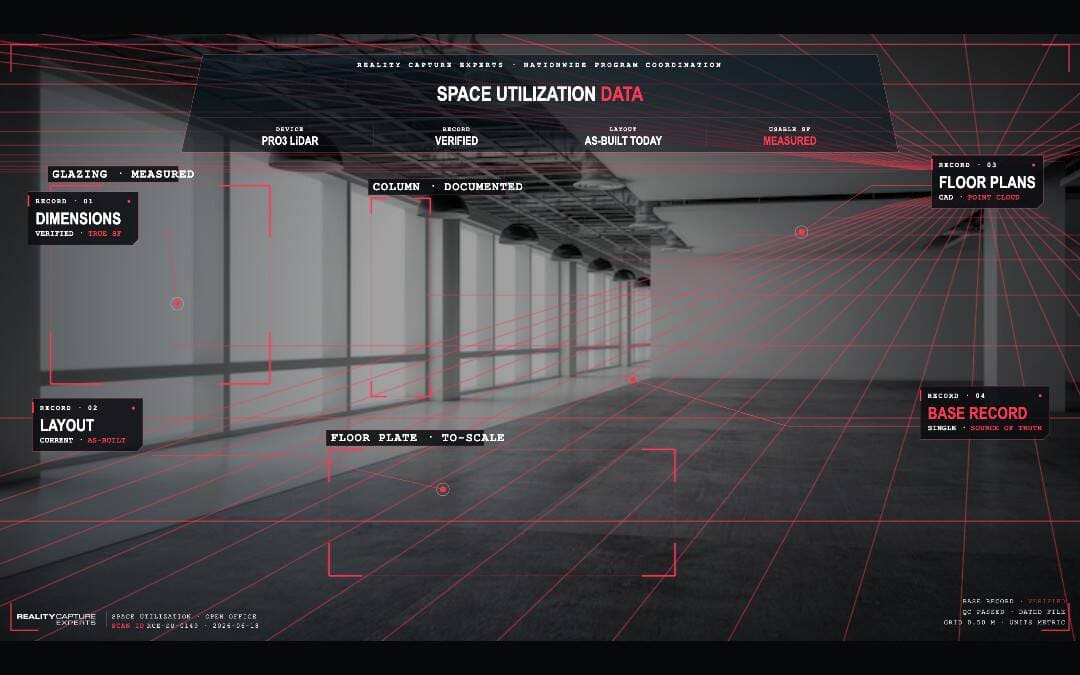
You get reliable space utilization data across buildings by starting from an accurate, consistent record of what each space actually is — its true dimensions, layout, and current configuration — captured the same way at every site. Utilization numbers built on outdated or mismatched floor plans are unreliable no matter how good the analytics are. The measurable base record comes first.
Hybrid work changed how buildings get used, and most facilities teams are making high-stakes decisions about space without a dependable picture of what they have. This post explains why space utilization data goes wrong, what a reliable base record looks like, and how a managed capture program delivers it consistently across a portfolio.
Why is space utilization data so often unreliable?
It is unreliable because it is built on a shaky foundation: floor plans that no longer match the building, square footage that was never verified, and layouts that changed without being re-documented. Bad inputs produce confident-looking numbers that are wrong.
Two failures compound this. First, the base record drifts — a space gets reconfigured, a wall moves, a department relocates, and the documentation does not catch up. Second, peak-day noise gets misread as permanent demand, and average figures hide the real pressure points. You cannot fix the analytics problem until you fix the data problem underneath it.
At portfolio scale there is a third issue: every building’s data was produced differently, so the numbers are not comparable. Reliable space utilization data across sites depends on the underlying records being captured to one standard, which ties back to documenting facilities across multiple locations consistently.
What does a reliable space record actually require?
A reliable space record requires verified dimensions, an accurate current layout, and a navigable visual reference — captured at a known accuracy and kept current. That base record is what space utilization data, space planning, and stacking decisions all sit on top of.
A Matterport 3D digital twin captures each space as it currently stands, with measurements available throughout, so square footage and layout are verified rather than assumed. Where teams feed CAD or space-management systems, the same capture supports floor plans and, where needed, a point cloud. Defining the accuracy up front means the numbers mean the same thing in every building.
The goal is a single source of truth for what each space is, before anyone layers occupancy or booking data on top. With that base in place, the utilization picture becomes something you can act on.
How do you keep space utilization data comparable across a portfolio?
You keep it comparable by capturing every building to the same standard and re-capturing on a defined cadence, coordinated centrally. Comparability is the whole reason a portfolio owner invests in space data — without it, each building is an island.
This is hard to achieve when each location is left to manage its own capture. Different operators, different scopes, and different formats produce data that cannot be compared site to site. A managed program removes that variance: RCE captures every site the same way, runs QC on every deliverable, and delivers consistent formats, so your space data lines up across the portfolio. When a building changes, re-capture is scheduled so the record stays current rather than quietly going stale — the same discipline described in facility handover documentation.
Frequently Asked Questions
Does RCE provide occupancy or sensor data?
RCE delivers the measurable base record — verified dimensions, current layout, and a navigable 3D reference — that occupancy and booking data sit on top of. The sensor and booking layer comes from your space-management tools; our role is to make sure the underlying spatial data is accurate and consistent. Note that Reality Capture Experts has varied relationships with third-party providers that extend preferred pricing for RealityCapture Experts customers. .
How accurate are the measurements?
Capture accuracy is defined up front to match how the data will be used. For space planning and floor-plan generation, the Matterport record plus, where needed, a LiDAR point cloud provides measurements you can rely on across every site.
Can the data feed our CAD or space-management system?
Yes. The same capture supports floor plans and point-cloud or CAD outputs that feed downstream systems, delivered in consistent formats so every building’s data integrates the same way.
How often should space records be refreshed?
After any significant reconfiguration, and on a defined cadence for active sites. Scheduling re-capture centrally keeps the base record current so utilization decisions stay grounded in reality.
What Happens Next
For space work, RCE scopes the capture to produce a verified base record — accurate dimensions, current layout, and a navigable 3D reference — at the accuracy your space-management process needs, then applies that scope at every site. We coordinate scheduling across markets, deploy operators who follow the same procedure, and QC each deliverable before it reaches you. Your team layers occupancy and booking data on top of a base record that is consistent across every building, which is what makes space utilization data comparable from one site to the next. When spaces change, we re-capture to the same standard so the data does not drift.