
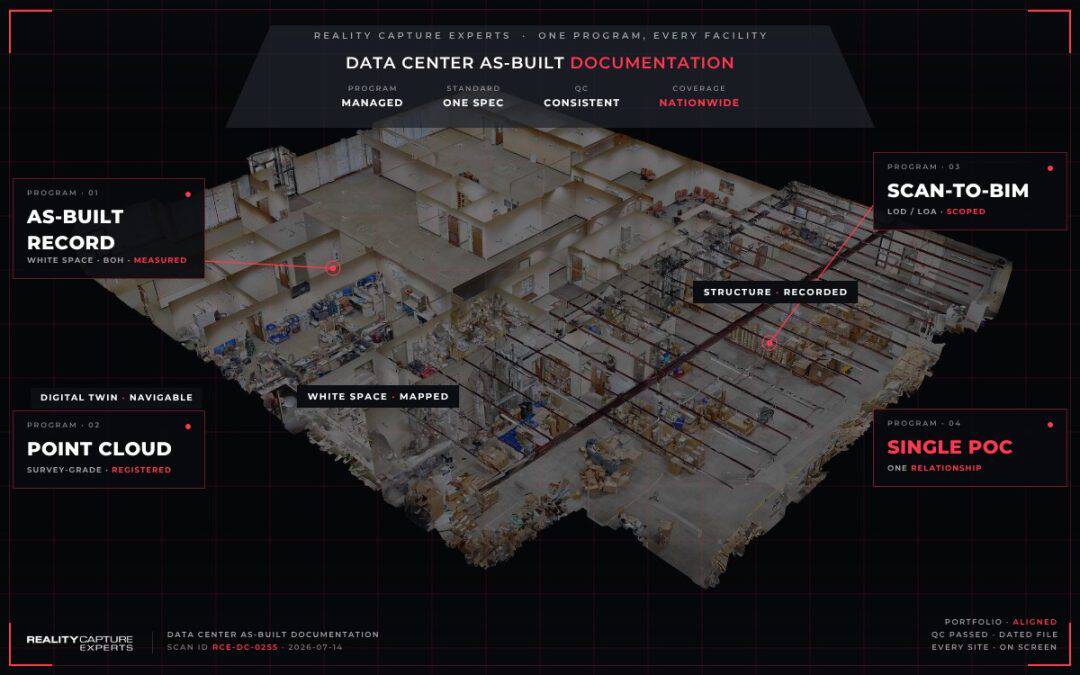
Data center as-built documentation stays accurate when you run capture as a managed program, not a series of one-off site visits. That means one point of contact, one set of standards, and a consistent QC process applied to every facility, so the documentation from a site in Virginia reads the same way as the documentation from a site in Arizona.
Most portfolio operators do not have a technology problem. They have a coordination problem. Any competent field team can scan a room. The hard part is making sure twelve sites, captured over eighteen months, by different people, using different conventions, still produce documentation you can trust when a technician is standing in front of a live electrical room at 2 a.m. This post explains how RCE handles that, and what to require from any capture partner.
Why Does Data Center As-Built Documentation Drift Out of Accuracy?
Documentation drifts because data centers change constantly and the paperwork rarely keeps up. Every rack added, every cooling loop rerouted, every panel re-fed is a change to the as-built condition. If the documentation is not recaptured on a schedule, the drawings on file describe a building that no longer exists.
Phased construction makes this worse. Phased delivery brings capacity online in blocks – a portion of white space, power, and cooling first, then more later. That is good for schedule and cost, but it means the “final” as-built is a moving target. Industry references are consistent on this point: fast-moving capacity buildouts outpace static documentation unless recapture is scheduled alongside construction, not after it.
That is why data center as-built documentation has to be treated as a living record tied to a recapture schedule, not a one-time deliverable filed away at closeout.
What Makes As-Built Documentation Trustworthy Across Multiple Sites?
Trustworthy portfolio-wide documentation comes down to three things staying identical from site to site: the capture standard, the QC process, and the naming and delivery structure. When any one of those varies by location, the operator ends up owning the job of reconciling formats instead of trusting the record.
A single point of contact matters here more than it sounds like it should. When one person or team owns the capture standard across every site, drift between sites gets caught early – a technician using the wrong scan density, a missed mechanical room, an inconsistent file naming convention – instead of surfacing months later when someone is trying to compare two facilities side by side.
What Should You Require From Any Capture Partner?
Four things. First, a written capture standard – scan density, LOD/LOA targets, and file formats – specified once and applied at every site, not negotiated site by site. Second, a QC process that checks every deliverable before it reaches you, not a spot-check after the fact. Third, a consistent naming and delivery structure so any team member can open any site’s files and know where to look. Fourth, a single point of contact who owns the program across the whole portfolio, not a rotating cast of regional vendors.
How Does RCE Handle This?
RCE keeps data center as-built documentation accurate across a portfolio by running every site to the same written capture standard and QC process, referenced against recognized industry benchmarks like the Uptime Institute Tier Standard and the BICSI/ANSI-TIA-942 data center documentation standard, so the record stays trustworthy no matter which site or which phase of construction it comes from. One point of contact coordinates field technicians nationwide, and every deliverable goes through the same QC review before it reaches you, whether the portfolio is five facilities or fifty.
Related Reading
- How Long Does It Take to 3D Scan a Data Center?
- What LOD and LOA Do You Need for Data Center MEP As-Builts?
- How Does As-Built Documentation Support Data Center Commissioning?
- How Do You Standardize Data Center Documentation Across Multiple Sites?
Frequently Asked Questions
Q: How often should data center as-built documentation be updated?
A: On a fixed recapture schedule tied to major change events – new racks, rerouted cooling, or a completed construction phase – not left until the next renovation or audit forces the question.
Q: Does every site in a portfolio need the same LOD and LOA?
A: Not necessarily, but the standard for setting LOD and LOA needs to be the same everywhere, so any variation is a documented decision rather than an inconsistency.
Q: Who should own as-built documentation across a multi-site data center portfolio?
A: A single point of contact accountable for the capture standard and QC process across every site, rather than each facility managing its own local vendor.
Q: What happens if documentation across sites was captured inconsistently in the past?
A: A managed capture program can bring older sites up to the current standard on a rolling basis, so the portfolio converges on one consistent record over time.